

21 Jul Living With My Ancestors
 A Ritual to Honour My Ancestors
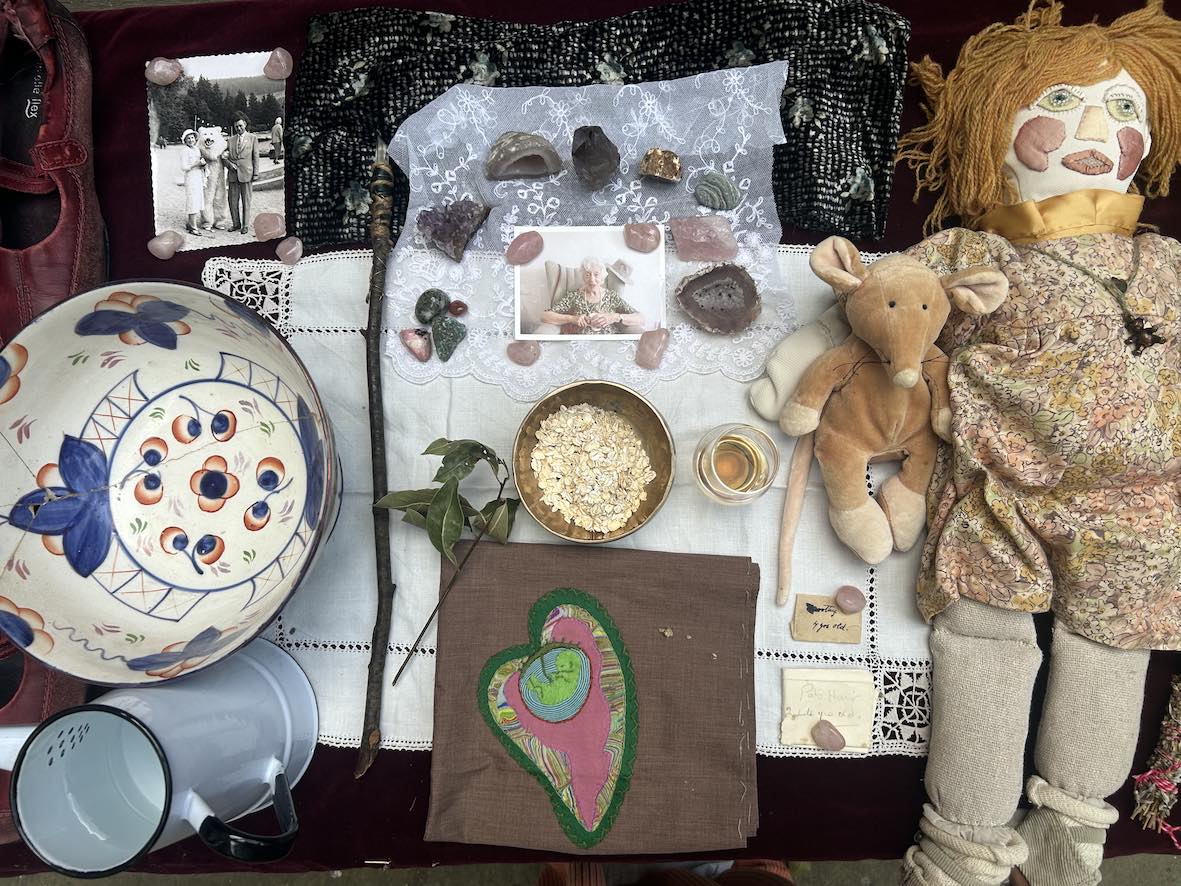
I gathered a collection of fabrics and mementoes made or owned by some of the women who came before me, in order to carry out a ritual. My intention was to burn a box of letters, to clear any unfinished business with them, and to offer healing to their writer, and thanks to the spirit of the women I am descended from.
Ancestors of Blood and Spirit
I want to acknowledge that ancestors can be tricky or tricksters, and our relationships with them may not be straight forward. For me, I consider that I have ancestors of blood – the biological family from whom I inherit my DNA, and of spirit. Spirit ancestors for me might or might not be blood relatives, and includes people who inspire me that I’ve never met. I also include divine archetypes and animals I have known and loved – domestic and wild creatures with whom I have made a bond or have a symbolic connection.
Spirit ancestors help me to find the best in myself, and I envisage their benevolent presence and use them as inspiration for my own path. They may have reflected something at a time when I needed it, or continue to be part of my envisioned helpers. I like to make offerings of incense, oats or thanks to these beings when I call them to mind. It supports me to imagine a host of known or unknown beings as part of the mystery of life.
The people I am descended from are a mix of those I knew and loved, and also people I have some complicated responses to, as well as those that I never met. Part of my inquiry into the wider field of my ancestry includes an intention to offer healing back in time from the present. I want to live in right relationship with my ancestors. As Malidoma Somé suggests, I want to find grace and beauty in my ancestral tree.
Dagara people’s main job is to look the dead in the face, to treat their bodies not as remains but as temples of grace and beauty continuing from this world to the other. People grieve the passing of loved ones, though in this grief they stress beauty and community and continuity.
Becoming an Ancestor
It is true for me that as I grow older, I become more conscious of being on my way to becoming an ancestor. I see myself as part of a continuum, as one person on a time line from ancient history to an uncertain future via who I am in the present.
I am the end of the line. I don’t have biological descendants. I am the last one in this particular branch of my father’s lineage, and surname. In my mother’s line, there are others to pass on the genes. As the full stop in one family line, I feel a certain task to end it well.
Living With My Ancestors
I grew up in fairly threadbare circumstances, but when my grand-father died in 1973, portraits of my great-great-great grand-parents came to live on our walls. I found them a bit creepy, and other-worldly. When the house we were living in nearly burned down in a forest fire in 1976, it was my three times grand-parents Sarah and John that my father evacuated first.
A Legacy of Stuff
Along with the portraits, my grand-father left us boxes of papers, photographs, treasured trinkets and some broken furniture. My great grand-father had sawn old wardrobes and cupboards into sections to facilitate frequent house moves. It didn’t feel like an inheritance of any worth. In the fifteen years until my father’s death, the boxes sat gathering dust. My Dad did some digging to identify addresses where his relatives had lived over the previous century, then went on a tour to visit former residences in Shropshire and Edinburgh.
When he died in 1988, the boxes lay dormant for the next twenty years in my mother’s damp basement. When she downsized to a single room, I took possession of this mouldy legacy. I felt like the victim of generations of people who couldn’t throw things away. I also felt responsible for finding out what was in the boxes. The wonky furniture was unceremoniously disposed of.
After another twenty years, with the weight of history on my mind, and attic, I took the notebook of a lace-bonnet wearing Sarah, a bottle of brandy, and a picnic to a church yard in Shropshire. My partner and I spread a blanket and shared the picnic, leaving some to feed the ghosts. The names on grave stones had been worn blank by rain. I talked to my ancestors. I thanked them, and asked them to help me to deal with the stuff that they had left behind. It felt like an overwhelming project, and I didn’t know where to begin.
Having kept things, and passed them down, over several generations I felt unable to just throw it all away. It felt important to at least try to discover what this unwanted legacy contained. I have been working very slowly to find out more about what it contained for the last eighteen years. I have examined the stash, read letters, taken photographs, made drawings and written poems.
I did fill bin bags with dull letters from my young father to his Aunt Emily and her boring replies. I was fascinated to read the correspondence from my great-great uncle to my young grand-mother while he sojourned in Christmas Island, and I have pondered stained and waxy deeds of probate from people who all shared the same first and second names. I have catalogued many of the items that are valueless, but venerated only because of their age.
This forensic examination of the left-behind fragments of unknown lives has given me a deeper sense of heritage, of lives very different to my own, although perhaps with some heritable quirks. Like millions of others, I have also scavenged through digitised documents on Ancestry to piece together some of the chronologies of the lives on folded papers in illegible Victorian scripts in my possession.
Unburdening Family History
Having learned what the old boxes contained, I am now divesting myself of anything that may be of value to someone else. I want to honour my ancestors without burdening anyone with having to deal with my family’s historical artefacts when I die.
The National Railway Museum has lifted some of the weight of papers inherited from two engineers and a mathematician. Other things have been offered as donations to archives, and the rest can be recycled, but I will have done due diligence.
Honouring My Mother’s Line
I love textiles and stitching. My Mum and granny encouraged me to make things out of fabric scraps. I knew how to use a hand sewing machine by the time I was eight. This feels like a skill that has been passed down from the hand-loom weavers, rope-makers, mill-workers, second-hand-clothes-dealers, and tailors who comprise my Mother’s line.
I arranged a piece of wedding veil, a scrap of velvet dress, locks of hair from my Mother and granny, a broken and glued-back-together-again bowl, and a piece of embroidery along with oats, brandy, mugwort, and bay leaves amongst other things. My Mum made her inner child a doll, and wrote letters between her adult self and ‘Little pat’. I intend to give ‘Little Pat’, the doll, to a young relative, clear of emotional baggage.
In my small ritual, the letters burned, gusts of wind taking ash across the back yard. The words on the pages stretched back to another time, when distress was my mother’s constant companion. The fire melted each page, my mother’s anxieties disappearing in the flames. Her ashes scattered ten years ago, this written legacy is now also transformed by fire.
The married women who I am descended from took their husbands names, so there are many maiden names that disappear in my line of mother’s, mother’s, mother. As I grow older, I am preparing to take my place in that line. I am learning to live with my ancestors, to honour them, to find the beauty and connection in their failings and their gifts.
Sarah Pletts is a Grief Tender and Artist who offers workshops in London and online, sharing rituals where grief on all themes is welcome. For more information about Grief Tending events see here.
No Comments