
Remembrance/Gratitude/Praise Tag

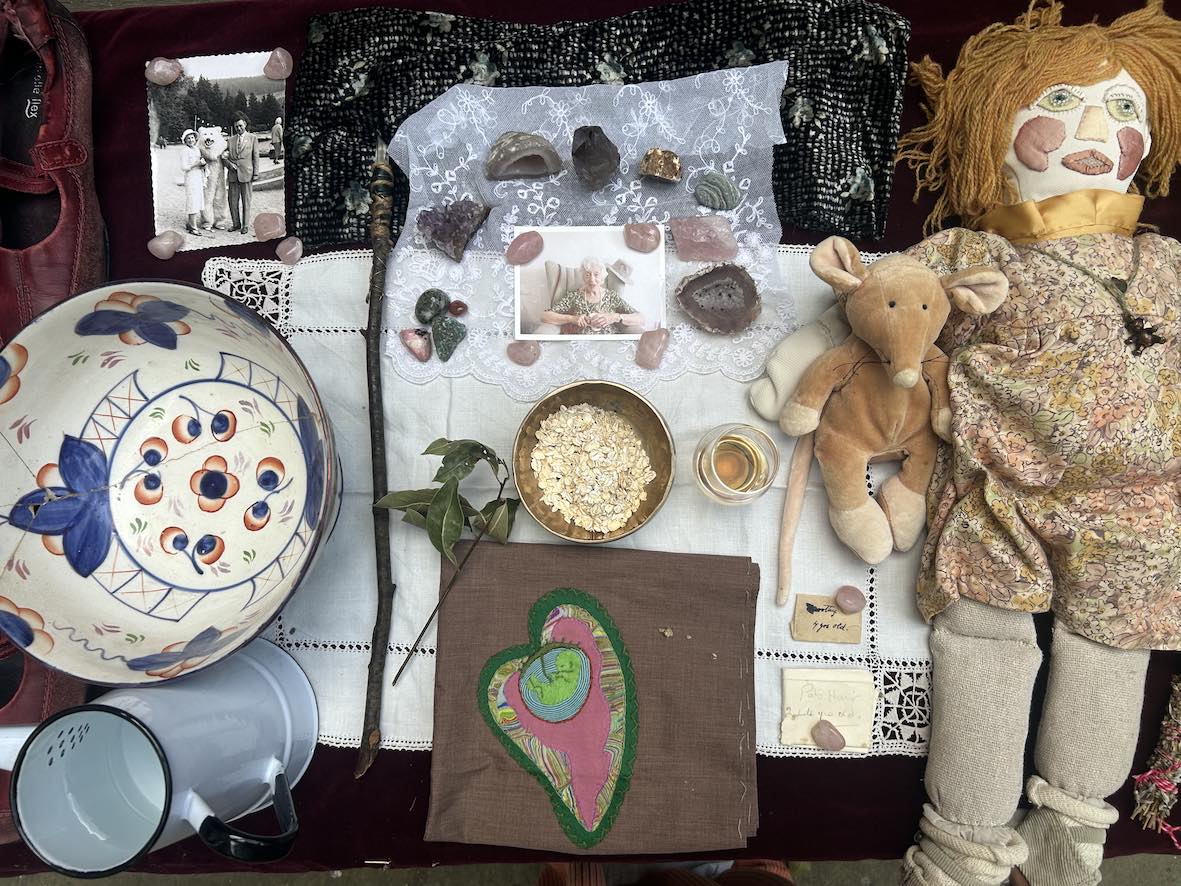
In many of our workshops (Online Support Circles, One Day Community Journey and Weekend Community Journey) we invite participants to bring linking objects. One or more object to represent something that is supportive, and one or more that helps people to connect with their grief. A linking object may help someone to connect to someone who has died, as part of a Continuing Bonds process (Klass, Silverman and Nickman). It may represent both support and grief of any kind.

In Grief Tending, we begin by encouraging people to focus on the things that support them. An object might be one kind of support alongside many other supportive practices and ideas. People bring all kinds of momentos to use. The object itself may be satisfying to touch, sitting snug in the palm of a hand, or perhaps on a chain around the neck, so that it can always be reached for. A familiar object can be a touchstone to reassure.

In addition to its physical presence, an object for support may have an association, a reminder of something significant, or be a keepsake of personal value. It may have been a gift, something from a significant location, a symbol of faith, luck, beauty or simply something that reminds us of someone.

Often something chosen to offer its supportive presence might also be linked with loss – a linking object. It might be a piece of jewellery gifted or inherited for example or the photograph of someone held dear who has become an ancestor.

One of the practices we may use in a workshop is Betty Martin’s ‘Waking the Hands’ from the ‘Wheel of Consent’. Our hands are sensory receptors, and exploring the touch of an object can be an excellent way to increase awareness, sensation and help us to activate our rest and digest system. This externally focussed touch can be a helpful way to bring attention into physical sensations and present moment awareness. ‘Waking the Hands’ can be explored as a regular practice to increase receptive sensitivity and as a cornerstone of embodied consent.

Many of the people I meet reveal touchstones that they keep in a pocket or close at hand for comfort and calming. In childhood, an object – mine was ‘the fluffy blanket’ – can become a stand-in when a care-giver is not available, in order for a child to manage anxiety. Throughout life during challenging times, a ‘transitional object’ might also become significant to help us to manage feelings.

Any of our senses may be involved as this particular object brings comforting sensations and allows us to keep in touch with someone who has died, for example. As a linking object, the smell of a longed for person may linger in their hair-brush, scarf or hand-bag. In Euphoria, the central character Rue Bennett continues to wear her father’s baggy burgundy hoodie as she grieves.

Linking objects chosen to help people to evoke grief may have a different emotional affect. They may represent more challenging experiences of connection with or disconnection from what has been loved and lost, an absence or active hurt. As with supportive keepsakes, the grief associated may be invisible to the casual observer. These objects may reveal intimate moments of distress, or bring forth the telling of a story.

At Grief Tending events, we invite people to use these objects to connect with feelings (if they choose to), during a ritual for the expression of emotions. Someone may titrate between grief and support objects to manage moving between resourcing and the expression of grief.

At home, having a special place to honour someone can be a helpful practice. It may be a small shrine or altar, or simply be somewhere that a linking object might be placed in remembrance. And it may be that a box of keepsakes to return to occasionally feels more manageable.

After someone has died it may take months or years to sort through their legacy of objects and clothes. I am still trying to figure out what to do with some of the things that have been left behind by ancestors. It takes the time it takes to process what remains, but choosing one or two objects can be a helpful way to maintain significant connections. I find my mother’s dental bridges particularly poignant, and my step-grandmother’s shoes seem to embody her movements as well as her style.

For some there may be an absence of objects, removed access or estrangement from them. In this instance it may feel helpful to choose something and imbue it with linking significance or memories that intuitively feel appropriate. This might be a creative opportunity to make something that signifies remembering someone. Other things, such as a plant, a time of year, a scent or piece of music may also link us with chosen memories.

However you choose to use them, whatever they are, objects can help us to connect in ways that support our grieving process. They may be used as part of home grief rituals or support us at a workshop, and they may help us to link to a sense of continuity with what has passed.

Sarah Pletts is a Grief Tender and Artist who offers workshops in London and online, sharing rituals where grief on all themes is welcome.  For more information about Grief Tending events see here

'UK AIDS Quilt' shown at Tate Modern 2025

The UK AIDS Quilt is a series of 42 large panels plus 23 smaller textile panels to commemorate over 380 people who dies of AIDS in the 1980’s and 1990’s. It was also designed to raise awareness of the ongoing AIDS pandemic.

Each panel is comprised of about 8 individual textile pieces. Each piece is made to remember someone. Friends and families have sewn and painted names, dates, images, symbols and words that reflect each person represented. There are a few famous names portrayed too including Bruce Chatwin, and Denholm Elliott. There are more details about each panel including the names of those who died on the UK AIDS Quilt website.

Shown together at the Tate Modern, the quilt brings a joyous clash of colours and styles – more outsider art than usually adorns the space. It is lying for a few days in the cavernous Turbine Hall, which easily swallows its length. Despite the Quilt’s size, it is only a small representation of the impact of lives lost in the AIDS pandemic in the 1980’s and 1990’s.

A lot has changed since the first case diagnosed in the USA (1981) and the UK (1982). This is thanks to effective testing, information about transmission, antiretroviral treatment, needle exchange programmes, blood product screening and treatment as pre-exposure prophylaxis with PrEP. For those in communities most challenged, there were often frequent, multiple reasons to grieve as thousands died. For more information about the shifts in infection rates, treatments and different demographics affected by HIV/AIDS, see AIDS Map.

My cousin was diagnosed with HIV in 1986, and eventually died ten years later. During the last weeks of his life, I began to understand the nature of the disease, as I sat at his bedside watching its cruel progress on his fragile body.

I now wish I had joined in this creative memorial act at the time and made an oblong of vibrant colours stitched to mark ‘Amaya Ben’s’ dance through life. I imagine how this might sit among the groovy cat and music lovers, the religious, the irreverent and uniquely personal representations that now tell an important piece of our collective cultural history.

To mourn losses old, new, and systemic, find Grief Tending workshops here, and for a space that is LGBTQIA+ focussed we also hold Grief Tending events at Queer Circle.

Sarah Pletts is a Grief Tender and Artist who offers workshops in London and online, sharing rituals where grief on all themes is welcome.  For more information about Grief Tending events see here

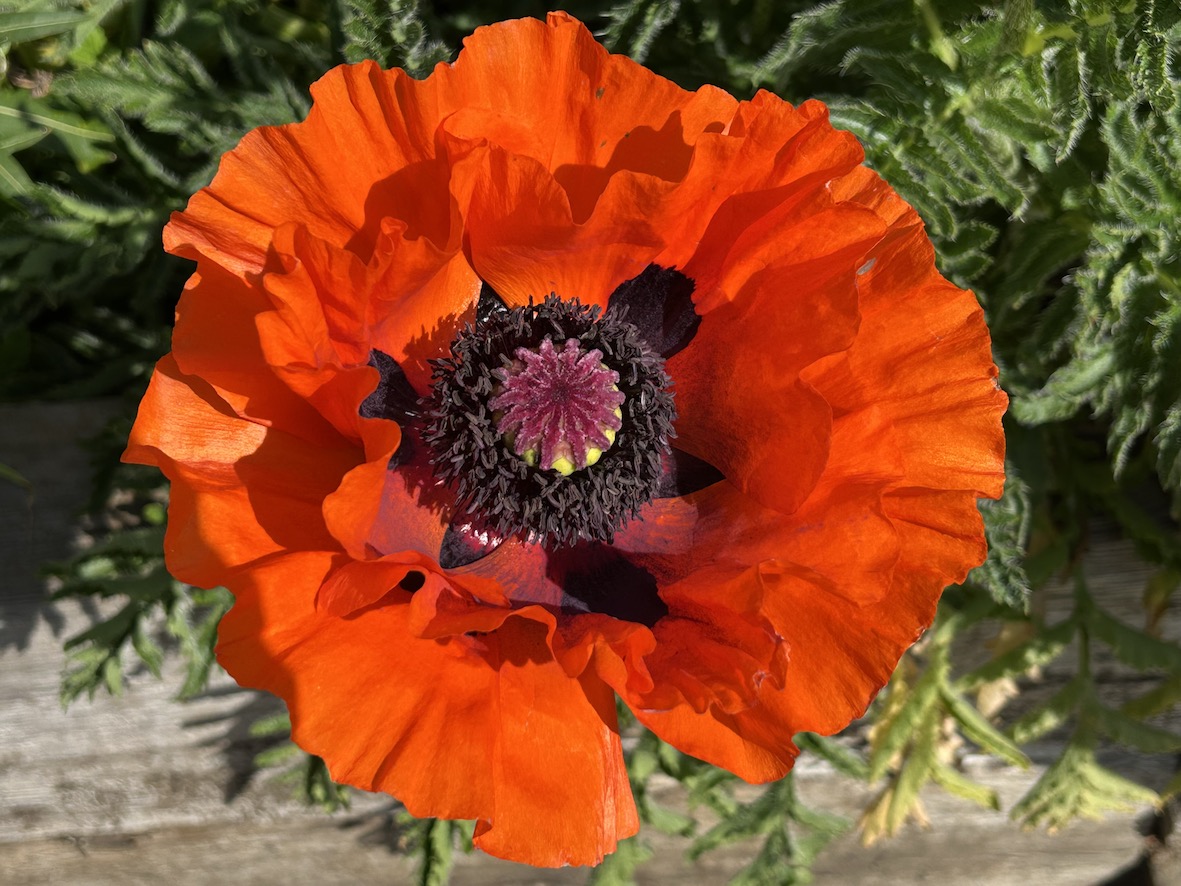
Poppy in full bloom to represent the flourishing of Grief Tending.

We have been collaborating with Sophy Banks of Grief Tending in Community to track the way that Grief Tending is flourishing. It is becoming more widely known, and spreading geographically. Many more people are offering the practice and there is a growing number of people who have attended one or more Grief Tending workshop, ritual or event.

Introduction to Grief Tending Audit

Grief Tending in community is a practice that involves a group of people coming together to share grief, with space to express their emotions. It can be a life-affirming experience and in addition to providing support and relief for current grief, can help people learn skills to cope with grief. Grief Tending events including a range of practices: simple exercises for participants to build trust, group ritual to express and witness feelings, embodiment to regulate the nervous system.

In Grief Tending events, all kinds of grief are welcome. We honour loss, absence, longing and change, and reconnect with intimacy and belonging. Grief tending is rooted in the teachings of Sobonfu and Malidoma Somé, Joanna Macy, Martín Prechtel and others, and has been shaped by teachers including Maeve Gavin, Francis Weller and those in this network.

Grief Tending events take place in a variety of face to face and online settings, including: an existing community, a group of people who come together temporarily, and a group who meet regularly.  Each Grief Tending event is facilitated by Grief Tenders.

In 2024 a preliminary audit was undertaken of Grief Tending events in order to observe and record the range and diversity of current practice

Audit Methods

Grief Tenders recorded and shared information on their face to face and/or online events. Information on the date and length of event and numbers of facilitators, assistants and participants was recorded in an online spreadsheet. This information was then summarised.

Note that we recorded the numbers attending each event. Some will be returners, so the total number of people who have attended events is less than the number shown here. We estimate that between 10 – 25% of people have been to an event before.

Results Show Grief Tending is Growing

Eight Grief Tenders shared information on 225 events held between 1/12/2013 and 31/12/2024, where grief was shared and witnessed. In total there were 3066 people attending (including a total of 720 at two festivals in 2023 and 2024). Participants joined from all continents (except Antarctica), the majority from the UK, followed by Europe and the US and Canada.

The number of Grief Tending events increased over time. The duration of both face-to-face and online events varied widely.

There were multiple short online events – some lasted 1 hour others 4 hours and others were all day or over multiple days. The longest online programme is the Apprenticing to Grief, which runs over 3 weekends.

The duration of face-to-face events varied from one or more hours, to workshops which ran over four days, and the Apprenticing to Grief over six days. Most face-to-face events lasted for 1 day or 3- 5 days.

All events (online or face-to-face) were led by a Grief Tender and supported by at least one other Grief Tender, facilitator or assistant.

Developing our Research

We believe this to be the first audit of Grief Tending events. Some participants have taken part in more than one event, so the total number represents workshop spaces attended. The number of unique people who attended is estimated at around 80% of this figure. Some figures provided by facilitators are estimates based on average numbers attending workshops.

Our initial objective in gathering this data was to sense the impact and reach of this network. In 2025 we aim to gather more comprehensive information from more people who are holding spaces. We would also like to see what else has resulted from attending the Apprenticing to Grief programme.

Many of us holding workshops gather evaluation information at the end of a workshop, or invite this feedback from participants online afterwards. We believe Grief Tending in community to be a low-cost, high impact intervention to improve mental wellbeing of those impacted by bereavement, loss, past trauma, stress, and life changes. We also believe it can have beneficial effects on those around people who come, which would be harder to measure. We would like to understand more about the impact of these practices on those who have attended Grief Tending events. We are exploring the best methods for doing this e.g. a survey of people who have attended.

Thanks to all those who shared their data, and all of you who are helping this vital work to spread to those who may need it.

You can find Grief Tending workshops with the Embracing Grief Team in London, Devon and online here. For the Apprenticing to Grief programme online or in person see here.

Sarah Pletts is a Grief Tender and Artist who offers workshops in London and online, sharing rituals where grief on all themes is welcome. For more information about Grief Tending see www.griefsupport.org.uk .

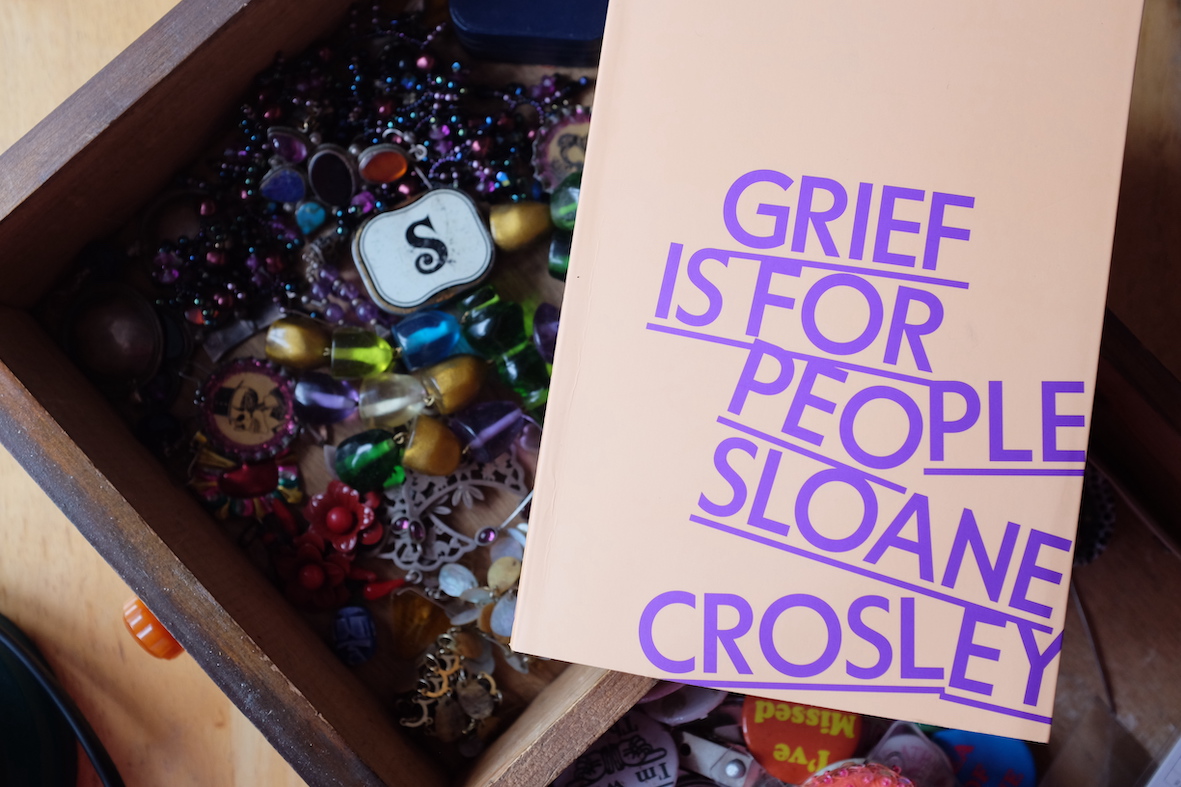
'Grief Is for People' Book shown here with a jewellry box which relates to the first chapter of the book

Sloane Crosley is a metropolitan New York wordsmith, author of ‘Grief is for People’. It is an exploration of the ways different forms of loss and absence take hold in her life. It begins with a jewellery cabinet.

She uses original metaphors, relishing in language.
“But the trauma humps my leg like a dog. I pick at memory scabs, recalling the sound of the amber amulet sputtering along its chain.”
Familiar with the literary sphere, she echoes and sometimes quotes from Joan Didion’s writing.

Crosley paints a detailed portrait of a close friendship. She describes the holes left behind in its absence; the way another’s death can take our history along with it.

I enjoyed its portrayal of the impacts of death and loss that happen in myriad ways in ordinary lives. It took me into an unfamiliar city, and the professional and sometimes funny world of agents, publicists and writers. This setting is itself in transition as she writes through pandemic, and other gathering forces – like social media and AI.

It is not a dramatic memoir of traumatic partner or child loss. It is, however, valuable to describe the loss of a close friend. This will inevitably happen to us all over and over again as we age.

‘Grief is for People’ is not a how to guide for facing loss, but it may ring a chord if you are melancholy or haunted by what has gone. Crossley examines the interplay between past and present.“I have read the grief literature and the grief philosophy and, God help me, listened to the grief podcasts, and the most practical thing I’ve learned is the power of the present tense. The past is quicksand and the future is unknowable, but in the present, you get to float. Nothing is missing, nothing is hypothetical.”

Grief Tending workshops are for people processing loss, absence and change and not just bereavement. You can find events online and in London here.

Sarah Pletts is a Grief Tender and Artist who offers workshops in London and online, sharing rituals where grief on all themes is welcome.  For more information about Grief Tending events see here

Ritual to remember the dead as described in the text, lighting candles and offering flowers.

In the northern hemisphere we put our clocks back one hour and turn towards the darkening of winter. The old festival of Samhain – a time to remember the dead, is now marked with acrylic spiders and festoons of tape marked, “Caution, zombies”. I can’t help thinking of ‘Shaun of the Dead’, which for me is a brilliant metaphor for the disconnection or zombification often necessary to tolerate the drudgery of meaningless work in dysfunctional modernity.

Scratch below the surface of the ghoulish costume of Halloween to find the old way of remembering how to honour the dead. Our deep-time nomadic ancestors would have known of the good pasture created where someone was buried along the path. This connection between composting in the dark months to bring new growth in the spring is often misplaced by the temptation to be only with the light.

It can be a helpful way to tend our personal losses by deliberately making a small gesture or ritual to honour those who came before us, in the growing darkness of the season. Pour a drink and put it by a photograph, or set a place at the table for a special meal to acknowledge someone who is no longer with us in person. Decorating a special place or altar can be another way to honour ancestors, perhaps offering oats, incense or flowers. This may include photos of pets, family and friends who have died as well as personal symbols or icons.

And in these times of war, oppression and unrest around the globe, it may feel helpful to light a candle or pour water for all those who have died. It can easily feel overwhelming to hear news from places where violence is ongoing. A small ritual act – like lighting a candle, reading a poem, offering a prayer may help us to face ‘the Sorrows of the World’ if only for a short time.

And if moving towards the festive season brings ominous dates, anniversaries, anxiety or too much time alone, we offer Grief Tending workshops to soothe our souls in community and find connection.

Sarah Pletts is a Grief Tender and Artist who offers workshops in London and online, sharing rituals where grief on all themes is welcome.  For more information about Grief Tending events see here

Image from an event described in the text, showing people placing grief messages on altar or shrine.

The ‘Day of the Dead’ theme has struck an increasingly powerful chord in youth culture in the UK over the last few years. ‘El Dia de los Muertos’ as it is known in Spanish has evolved and spread from Mexican culture, blending indigenous and Christian traditions over the centuries. The film Coco’ popularised the theme in 2017 for a generation of young people.

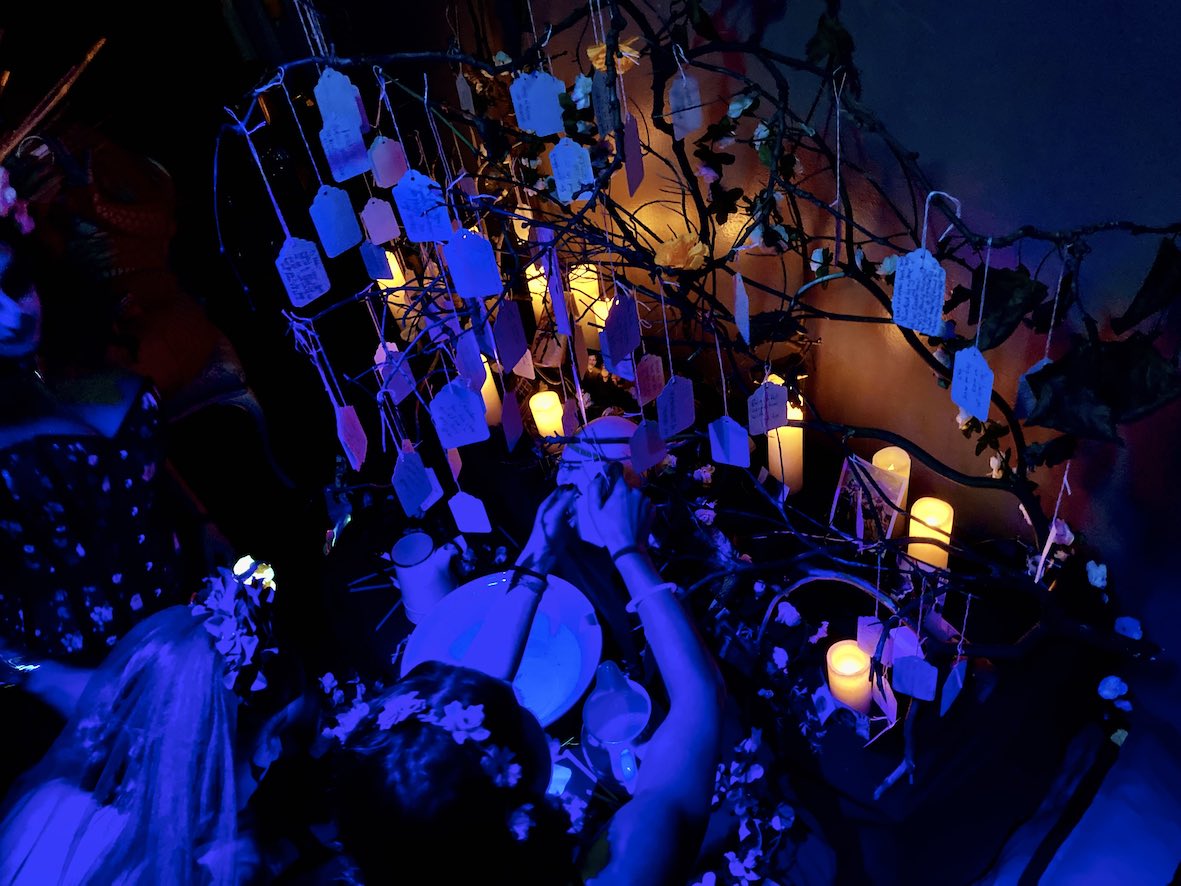
But it is more than a time for Halloween dressing up with tricks and treats. Many are hungry for a deeper connection with mortality, with ancestors, with acknowledging those who have gone before. People came to our pre-party workshop at Fox and Badge to mark their own private sorrows, and also collective themes.

Tony Pletts, Bilal Nasim and I are being invited to devise ‘Embracing Grief’ rituals for different settings. These take different forms to suit the situation, and number of people. Recently this has included a large community ritual at the Medicine Festival for around 120 people (with Sophy Banks), and a workshop designed for Fox and Badge for their Day of the Dead party for 40 or so participants. This took place in a night club at the beginning of a night of playful celebration.

When designing the format and content of an event, we have to consider what this particular group of people might feel comfortable with. In our Grief Tending groups there is often a wide diversity of social class, race, faith, age and GSRD (Gender, Sexuality and Relationship Diversity); and we aim to assist everyone to feel comfortable enough together in what is often very unfamiliar territory.

The basic shape of Grief Tending – the arc of experience, starts by bringing people together and recalling the support we have access to. Then we use trauma sensitive principles like ‘pendulation’ and ‘titration’ to move step by step towards feeling (or the absence of feeling). These are trauma tools originally described by Peter Levine. There is an invitation for some kind of expression, through different practices. Then we invite exercises to soothe the nervous system, followed by some simple integration processes. This basic pattern can look very different according to time available, number of people, location and setting.

The way we work has its roots in the indigenous practices of the Dagara People, blended with modern psychological understandings, and underpinned by neuroscience. You can see more in the short video ‘Where Does Grief Tending Come From?’ In bringing these strands together, we create an embodied way of working that adapts old ways for a modern, urban environment.

Some may suspect Grief Tending is ‘woo woo’; but bringing forms of grief ritual is both an antidote to a death-phobic culture, and a radical way to begin to process the trauma residues from systems of harm (check out Healthy Human Culture). As Audre Lorde so aptly puts it, “The master’s tools will never dismantle the master’s house”. The power of this work to increase our capacity for feeling awkward is one of its strengths. As one recent participant recently described, “this is the work of sacred activism”.

Standing before an audience of creatively costumed grievers was an interesting experience. Behind masks and face paint were beautiful, vulnerable humans that I probably wouldn’t recognise in the street. Tony, Bilal and I are no strangers to the carnival world of dressing up and immersive theatre, so we welcomed this invitation. Wondering whether our Francis Weller’s ‘Gates of Grief’ mats would be swept away by the train of a ball gown was a problem I hadn’t previously given any thought to.

We invited these colourful creatures to move between support and grief via two shrines. One ‘Love Shrine’ to express gratitude and praise, to count our blessings, and the other ‘Grief Shrine’, to mark suffering and loss. After the workshop, others came to add their own mementoes of remembrance to the growing number of griefs and gratitudes.

We were careful in the design of this event to tread gently. We felt it was important in this context to point towards but not to open up to deep exploration, where boundaries, communication and responses were more unpredictable than at one of our smaller gatherings. But the conversations and expressions that we encountered spoke of the need for both remembrance and play, and rituals to open us to the significance of both love and loss.

To discover Grief Tending events in person and online, or to invite us to create something for you email us.


Artefacts belonging to my father as part of the memorial act described in the text

There are times to grieve, and when it feels right, celebrating someone’s life can be another important acknowledgement. Everyone’s different, and this might be soon after a funeral, or years later.

Celebration Day is happening this year as a dedicated opportunity to do something special to remember someone. It might be a friend, family member, or a distant ancestor. Many people already mark specific dates – perhaps a birthday or anniversary. For others, there may be a longing for a wider awareness of the cycle of life and death. The rising popularity of Halloween and Dia De Muertos (Day of the Dead) point to this upsurge in hankering for communal rituals on this theme.

Love and loss are so tightly woven together, that the invitation to honour someone’s life will also create space to grieve. I know I can feel reluctant to make time to be with feelings. The intention is to have an annual day where we can plan to pay attention to someone we love, who is no longer here.

What you might choose to do is up to you. It could be a small personal tribute, or something bigger. Perhaps it might be a part of ‘finding meaning’ for you, as a project or gathering inspired by the person who has died. David Kessler names making meaning as one of the stages of grief (that may co-exist with or follow others).

It doesn’t have to be a huge gesture. I rang family members on my Mum’s birthday. Five years on from Rob’s death we gathered and sang Bowie’s ‘Five Years’, and then read out poems that were composed by him. You can see some ways to get involved on the Celebration Day website, and an invitation to submit your ideas and plans.

Nicholas McInerny has written ‘Common People’ inspired by his friend Andrew’s final days in hospice, (imagine latex, leather and dancing!) The play had its first public reading on Celebration day.

The death of my father John was an initiation that began my enquiry into mortality. His thesis – a large orange tome with his name, “CRS Thesis 1982” on the spine has been unread on my shelf for the last 34 years. Some words underlined on the synopsis include, “talking about feelings…caring for communities…responses to major social problems…discoveries about being ill-at-ease…” I wish I could discuss our common aims now. I have decided to spend some time this Celebration Day reading some of his words. I spotted a note in his distinctive hand-writing in the margin, which still has the power to catch at my heart. I have poured him a brandy, and picked a rose from the garden in his honour too.

We’re also hold regular Grief Tending workshops, in case you’re not yet ready to celebrate.

Sarah Pletts is a Grief Tender and Artist who offers workshops in London and online, sharing rituals where grief on all themes is welcome.  For more information about Grief Tending events see here

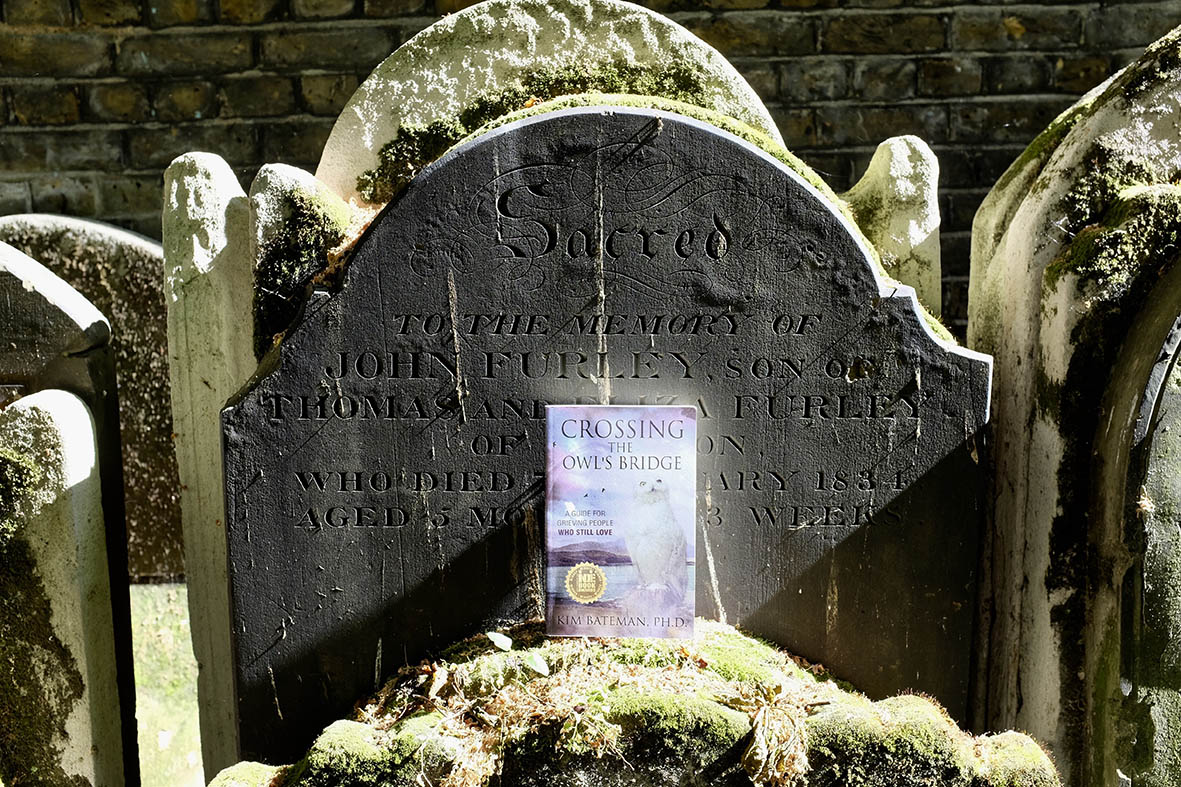
Image of the book described in the text set against a grave stone.

Kim Bateman’s ‘Crossing the Owl’s Bridge: A Guide for Grieving People Who Still Love’, is in itself a bridge between myth and real-life stories. With examples of folk tales from different cultures, Bateman takes us through the experiential processes that are shown symbolically in the narratives.

“As I began looking around at different cultures, and particularly their stories, I found that this theme of the loss of the physical coupled with a continued relationship in the imaginal is ubiquitous.”

Bateman correlates traditional tales with the stories of people who have experienced tragic losses and deep grief, and how they began their work of dealing with bereavement. Many of these short personal testimonies are heart-rending.

While grieving, the process she describes is for the bereaved to “create the symbols or rituals that you need to create a bridge – a bridge between you and your loved one.” This work of making-meaning, like the heroine Nyctea in one story, of bringing memories and mementos of a life together, can be helpful in actively coming to terms with, and changing the relationship with the person who has died.

Kim Bateman works with people who have lost their dear ones; she understands the initiation that bereavement can be. Her wise words come out of both personal experience, years offering grief work, and by listening to the sense below traditional folk tales. In the altered, liminal, non-linear grief space, myth and imagination can be really helpful tools to transform our relationships with the dead, whatever our beliefs.

She describes ‘Singing over bones’, which is also the title of her Tedx Talk.
“This mythologizing, or piecing together of memories, pictures, objects, among other things, is one of the ways in which the evaporated person takes form again.” I recognise this from the creative ways I have honoured my own ancestors’ belongings and histories.

Through acknowledging, being with, and tending to our losses, we may traverse through ‘the abyss’, and begin a journey of growing ourselves to be able to live with grief.

For our next Grief Tending events, please see here.

Sarah Pletts is a Grief Tender and Artist who offers workshops in London and online, sharing rituals where grief on all themes is welcome.  For more information about Grief Tending events see here

Letter and pair of shoes described in the text that are a part of the project.

These crimson suede shoes are potent grief objects for me. They hold the imprint of my Step-Grandmother Pat. The soles are worn from years of shuffling along the corridor of a care home. They held her unusually long, narrow feet in pop socks. Her striking home-made dresses in vibrant upholstery fabrics stopped just below the knee, revealing the red suede toes beneath. The dresses, these shoes, and her memory were worn out, misshaped by time.

As part of Natalia Millman’s ‘Grief Letter’ project, I have written Pat a letter. It is a love letter of sorts, a chance to express my sorrow and regrets. Our responses to grief are as many and varied as the causes, and the people we mourn. In writing a grief letter, Natalia gives us permission to speak from the heart. “Grief Letter is an ongoing community-based project where people can share their personal experience of loss and grief in the form of a letter,” writes Natalia about the project. The letters she receives are incorporated into a touring installation.

Millman has been exploring mortality and loss in response to her own grieving process. Her art works use a variety of media to experiment with these themes. Found and natural materials layer with photographs and sculptural forms. Many of her pieces are made with juxtaposing textures, and fragmenting imagery. In the wake of a parent’s disappearing memory, she creates visual remains that have the quality of decomposition.

Writing can be a powerful tool to use in the practice of tending our grief. Many people find journaling or free writing useful ways to download feelings. A letter to someone who has gone away or died can be a significant way to say what may not have been possible or welcome at the time. It can offer a chance to remember someone, to acknowledge them, as well as taking a step towards processing the feelings that remain in their absence.

Taking part in the Grief Letter project by writing your own letter will leave a document of your experience of grief that may resonate with others.

Embracing Grief also offers Grief Tending weekends that include writing as one of the central practices. Look for Embracing Grief: Weekend Community Journey.

Sarah Pletts is a Grief Tender and Artist who offers workshops in London and online, sharing rituals where grief on all themes is welcome.  For more information about Grief Tending events see here

Image of the artist demonstrating the theme of the post

This week I watched a friend’s funeral. I had not known them well although over a period of twenty years. It was an extraordinary event, for its authentic portrayal of a maverick, complicated, inspirational person, whose life-force burned bright and came to a sudden end.

I am not just mourning the loss of Tobias the person, but of the role he played in community. He organised events which created the conditions to foster connections. This collective is unravelling like a hand-knitted jumper which now has a large frayed hole in it. I am seeing the shape of the absence he leaves behind, like George Bailey in ‘It’s a Wonderful Life’.

The funeral stirred me to cry, laugh, and then dance. I am left with regret for the conversations we never had. I learned things about Tobias that I wish I had known before; and remembered many of the qualities described in heart-felt eulogies. He was, (amongst many other things), an advocate of inclusive sex-positive community, and driven to normalise taboos around desire.

“He used to share crying selfies with those he loved,” I learned. I took one to honour the moment, as I was in full flood at the time. I have long attempted to document a range of moods, and expressions in our family photos, and have taken crying selfies before. Showing our crying faces in public is another taboo. Tears are sometimes expected in measured ways, but messy outpourings of grief are often less permissible.

Sudden, unexplained, ‘out of time’ deaths can leave huge impacts. We are left wondering why, how, often with shock, regret, guilt or shame rippling out. Those left behind are often left with strong feelings; denied a timely way to express our goodbyes.

The pandemic brings in its wake a mental health crisis, along with many deaths that are complicated, have been without good endings, and with minimal funerals. Let us offer our gratitude to those we love, and let them know we love them while they are still here. Perhaps even send a ‘crying selfie’?

For Grief Tending events coming up, follow this link.

Sarah Pletts is a Grief Tender and Artist who offers workshops in London and online, sharing rituals where grief on all themes is welcome.  For more information about Grief Tending events see here