


07 May Involuntary Childlessness
 Socialised to be a parent
I remember my life-size doll with her short scratchy blonde hair, painted eye lashes, plastic hands and feet, and soft fabric-cushion belly. She was known as ‘the baby-doll’, and I dressed her in a pink terry-towelling baby-grow, and carried her around, imagining her my real baby. My female socialisation came with many unconscious messages, including the expectation of motherhood. It never occurred to me that I would be involuntarily childless.
Longing to have a baby
My assumption was that I would parent at least two children. This prompted an unrealistic search for male partners, keeping the alternative drivers of my sexuality out of my awareness. Despite my unconventional family and creative education, I saw myself as maternal and I didn’t question this narrative. I longed for a child.
What I assumed was a biological urge, a human imperative to breed, did not match with my ability to conceive and physical capacity, despite eventually being in a relationship where it might be possible. I longed to become pregnant and become a parent. I dreamed about this fantasy altered state, and frequently found my dream-self forgetting I was a parent, and misplacing my child. My internal alarm clock rang for years. I was unaware of the condition that meant I was probably unable to conceive. I had hormone checks, tracked my cycle, stimulated my ovaries with acupuncture and herbs, and made love diligently during ovulation, but conception didn’t happen.
The quiet despair of involuntary childlessness
‘Babies’ is a six-part BBC drama series which explores the subject of longing to have a baby through the eyes of Lisa and Stephen, played by Siobhán Cullen and Paapa Essiedu. Their journey unfolds with complex relationship dynamics between the couple, and parallel relationships with their friends. The desperate longing of the couple to conceive is layered with disappointment when it doesn’t happen. The different oblique communication styles of everyone involved compound the only-too-common tragedy that puts them through the mangle of grief.
This may be an especially intense watch if baby loss is a hot topic for you. And I suspect that watching the struggles of the couple may be a powerful mirror if it resonates with your experience. This is a warm, deeply human, sometimes funny portrayal of loss, hope and vulnerability. In the programme, family and friends of the couple reinforce the tendency to avoid, stay silent, deflect and hide their feelings from others. ‘Babies’ is a brilliant portrayal of a descent into the quiet despair of involuntary childlessness.
Toxic positivity to avoid grief
The social impulses of the protagonists reflect the shocking contemporary British tendency to avoid the subjects of miscarriage and childlessness and carry on. There is plenty of toxic positivity as the characters succumb to the temptation to button down feelings and hide genuine expressions of distress. The mismatch of these communication norms versus the felt experience of heart-shattering grief made me remonstrate out loud as I watched, (although me shouting at the television is not unusual). The template of mainstream contemporary culture as it is shown here meeting grief, is a believable portrayal of how we try to defend ourselves unsuccessfully against pain.
Coming to terms with involuntary childlessness
I was sad but sanguine, when I came to understand that I was not going to be a biological parent. My longing concluded with a period of grieving. I re-oriented my life, choosing to see conception as a gift rather than a right. I was also lucky to be an engaged step-parent, and felt able to accept this role with grace. I love being a step-parent, and am proud that my step-child now has step-children, and I am diving into the role of step-grand-parent.
If I’m honest, part of me was also relieved that I wouldn’t have to endure the challenges of the initiation of birth, and the sleepless nights, relentless care and unanticipated circumstances that often follows the birth of a child. I wasn’t entirely sure that I was strong enough to cope with all that biological parenting might deliver.
Subconscious desires to parent
Longing can be a deep desire to fill an unmet need. It felt important that I examine my subconscious motivations, as well as the more relational and practical aspects of the desire to parent. I longed to love and be loved, and I began to recognise that I couldn’t control how this might or might not happen. Was I hoping to offer to a baby what I hadn’t received enough of myself? As a child I longed for the siblings that never came. I learned of my two still-born ‘ghost’ siblings. My father’s baby brother died five days after birth. Was my own longing part of an intergenerational pattern of wishing for a missing child?
Different routes to parenting
As I explore with the guest interviewees on the ‘Rainbow Mums’ podcast, parenting can happen in many different ways. Blended families and chosen families are normal, and may include different kinds of parents, different modes of arrival, and different kinds of sibling relationships. Some of the interviews feature people who have used donor insemination, or have adopted a child as well as step-parenting. However, it is often the underlying impulse to parent that leads to intense longing, which may end with child-rearing, or may lead to deep disappointment, shame, or a sense of hopelessness.
Increased visibility of involuntary childlessness
For me, the series ‘Babies’ flags just how common issues around involuntary childlessness and fertility are, and how rarely they are shown on television. ‘Babies’ stands out as a realistic and warm-hearted examination of miscarriage and envy. It is just one story in a huge sea of possible human stories that might provoke grief around the theme of conception, birth, infertility and childlessness – whether voluntary or not.
Some reasons to grieve
Traumatic experiences around birth and conception are very common among the people who come to our workshops. People – and I mean people of any gender – may be suffering from direct or indirect experiences around the subject. We believe that every experience of loss, absence, longing or change is worthy of grieving. Some of the experiences that may bring people of any gender to seek a Grief Tending workshop include:
Involuntary childlessness
People may have gone through gruelling struggles to conceive, sustain a pregnancy or be an active parent.
- Miscarriages
- Still births
- Baby loss
- Unsuccessful rounds of infertility treatment
- Early menopause
- Biological infertility
- My partner doesn’t want to have kids
- ‘Social infertility’ (lack of resources or the right partner)
- Exclusion from the life of your child
Voluntary childlessness
Sometimes people make reluctant or pragmatic choices not to parent. They may be choosing not to have a child as a result of concern for their current situation or for the future. Or people may have made choices that they later regret. (When people are happy with the choices they make, they are less likely to want to grieve the outcome).
- Termination
- Social factors (lack of resources or the right partner)
- For environmental or ethical reasons
- I am not stable enough to be a parent
- I don’t want to pass on a heritable disease to my children
Re-parenting our inner children
People may be processing an early experience of their own. Many come to tend their inner child. Sometimes people are born into grief in some way.
- My own traumatic birth
- I was born to a grieving parent
- I was a replacement child after the death of an older sibling
- ‘Ghost’ children in my family who died and weren’t spoken of
- My parent was not available to parent me
- I was abandoned or adopted as a baby
- I was born into an abusive situation
- I was born into intergenerational trauma
Sharing the experience of loss and longing
Breaking the taboo to speak about our experiences of loss, love and longing opens doors to meaningful connections with others. As ‘Babies’ shows all too clearly, superficial banter and keeping positive at all costs imprisons us and fails to let others in. Our natural emotions including shame, self-judgement, envy and longing may feel bewildering. Emotional intelligence grows as we find others whom we can share our stories with, and express ourselves in ways that feel more authentic.
Finding avenues of support
Developing practices that support wellbeing also help us find the way back from heart-break or dysfunctional relating. To grieve well, we need ways to find relief, and people who understand and are able to witness our pain without minimising it. A gratitude practice can also be one way to shift focus back to the things that support us. Finding support in multiple ways is an important step. This may include friends, professionals, and a sense of being held by something greater than us.
Tending Grief is a way to be with our sorrows, while also growing capacity to be with our strength, becoming more resilient. We may do this in groups with others who are able to recognise what we have been through. Grieving in community is one way to connect with others in a supportive group. You can find our Grief Tending workshops here.
Creating meaningful rituals
Rituals can also help us to navigate loss and longing. We can create our own meaningful rituals. There are many different ways to honour or commemorate what has happened or what we longed for. We may have places we can visit to remember a particular loss. We may create a meaningful moment to acknowledge our hopes and dreams too. It can feel profoundly hard when there is no grave to mark the place, or when a being grows but dies un-named. We can create our own designated place of memorial, or action of remembrance. Lighting a candle, pouring water, making a symbol, giving an offering, singing or speaking at an appointed time or day can all provide a threshold to move towards grief and step back from again.
At the end of my attempts to become pregnant, I decided to close the door and stop trying. My partner and I held a small private ritual in which we both spoke the appreciation of our efforts in acknowledgement, and named our sadness. It was a simple but deliberate threshold moment that allowed us to grieve and step forward into the life that we had not imagined.
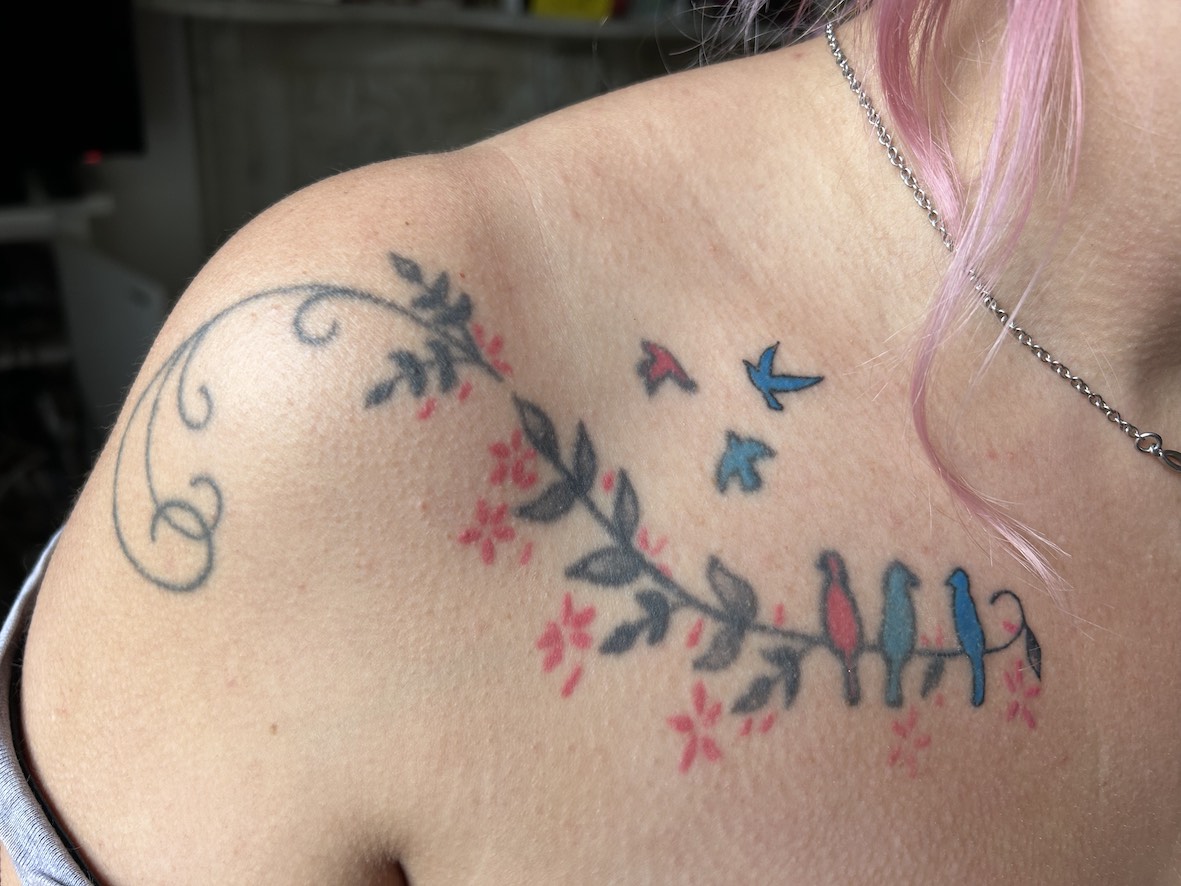
A symbolic tattoo
The commemorative tattoo in the image above was chosen by a friend. For her, it is a symbolic reminder of her three children who are alive, and their three spirit siblings who didn’t live long enough to join them. “I wanted it to be a talking point and a physical representation of the memories of them”, she says.
Re-imagining the future without children
Through grieving, we make space inside ourselves. After the loss of hopes and dreams, and their mourning, we may need to find deliberate steps to change focus. A personal ritual to honour what has been longed for but not received may be a way to acknowledge what hasn’t happened and let go in order to shift focus and move towards a different creative opportunity. My own switch from longing to creativity has allowed me to re-frame the projects that I continue to birth into the world. As Mary Oliver provocatively asks, “Tell me, what will you do with your one wild and precious life?” I invite gentle encouragement to re-imagine a future with self-kindness and flow into the mystery of what it is to be human.
For more sources of support including Sands who support bereaved families after baby loss, see our links page.
Sarah Pletts is a Grief Tender and Artist who offers workshops in London and online, sharing rituals where grief on all themes is welcome. For more information about Grief Tending events see here.
No Comments