
Remembrance/Gratitude/Praise Tag

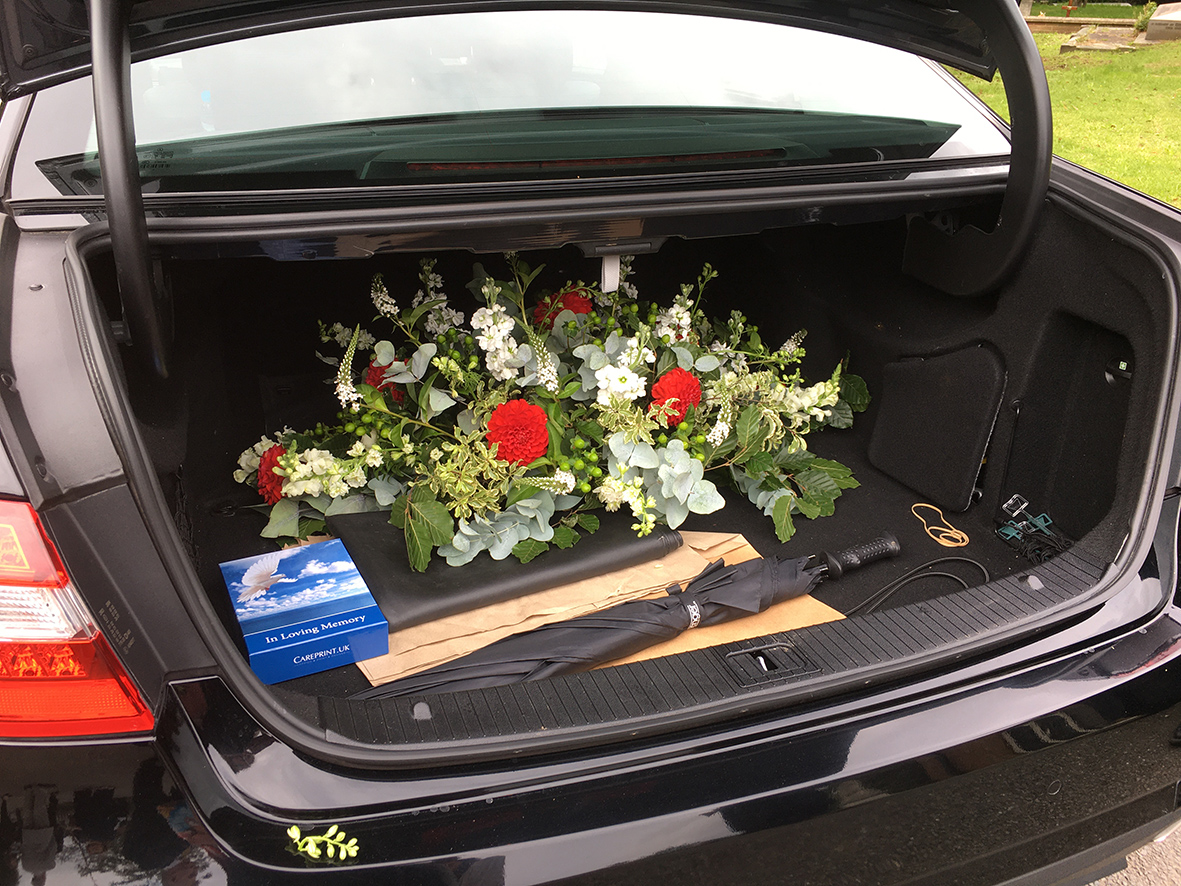
Image of hearse from the funeral described in text

One of my favourite films is ‘Harold and Maude’. The drama unfolds as two people fascinated with death make an unusual connection. The film, made in 1971 plays with the edge between funny and sad to explore themes that still feel edgy in 2021.

Like Harold and Maude, I enjoy a good funeral. For me, the design and execution of the event is satisfying when it is congruent with the deceased. Does it reflect the person who has died? Did I learn more about them? Did it give space for feelings? Was I able to participate in my own way?

As a child of a vicar, I saw inside the vestry and underneath the vicar’s cassock. Church, crematorium and theatre all function with back-stage and public spaces. I always want to pull back the curtain, to look behind the door marked ‘private’.

For the time of the ceremony there is a tableaux that may include coffin, flowers, music, mourners arranged in order of relationship. After the allotted time to mark the ending of a life, the scene dissolves, leaving empty vases and rows of chairs.

At the crematorium, there are curtains – which may or may not close, and a dais which may sink down or roll to disappear the coffin out of sight to complete the illusion.

The stage manager is the funeral director. The celebrant is supporting actor to the reluctant stars – the next of kin. We too, the audience are part of this immersive show; whether we shed tears, crumple tissues, or bow our heads.

The undertakers are the stage hands whose role is to attend the body and smooth us through the ceremony with practiced hands. This role is usually a traditional display of black, often with topper and tails. They move with respectful slow motion as they ease us along. With silent stealth they manage handles – hearse doors, coffin, chapel, and trip hazards – stone, marble or carpeted steps. Flowers appear and disappear, in this case into the boot of one of Poppy’s hearses, to arrive where they are needed next.

There are choices to make. Many more than you might imagine in creating the final spectacle to best reflect a loved one. Most of these are optional. There are almost no rules in law about this occasion, excepting disposal of a body. I recommend ‘The Dead Good Funeral Guide’ to help plan a funeral. The Natural Death Centre is another resource for finding independent undertakers who are willing to work with you to create the funeral you want.e tells you all you need to know about creating a bespoke memorial event. Beyond Life is a good resource for finding your way through the maze when trying to work out what to do after someone has died.

Sarah Pletts is a Grief Tender and Artist who offers workshops in London and online, sharing rituals where grief on all themes is welcome.  For more information about Grief Tending events see here

Samhain (an ancient Celtic feast of the dead to mark the end of harvest and beginning of winter on 31st October to 1stNovember) is celebrated in different traditions around the world, in different guises. Traditionally at this time of year, ‘the veil’ is a little thinner between the land of the living and those who have gone before.

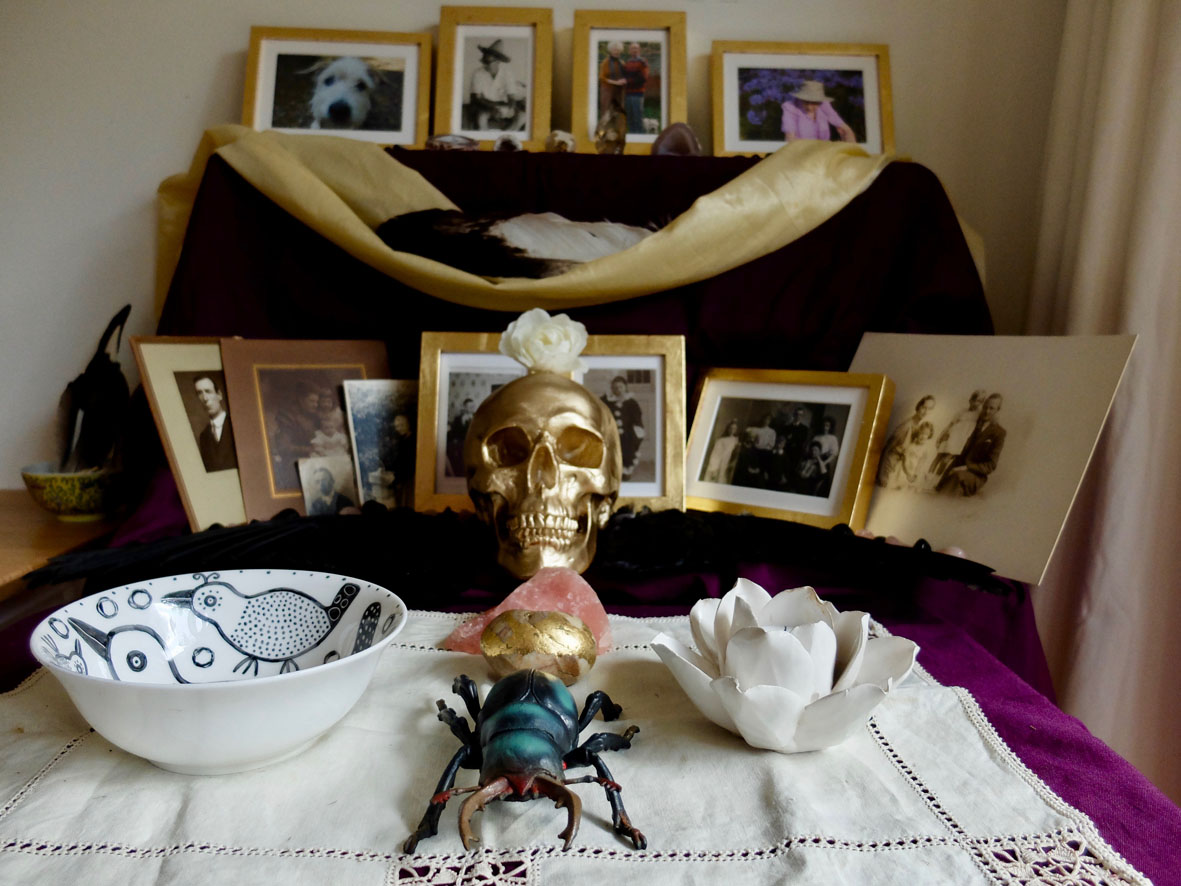
This is my shrine with three generations of family on display. Gold plastic skull and plastic stag beetle are here to remind me of the cycle of death and new life. Dead bodies (in their natural state) compost back into the earth, nourish the soil and support new growth.

I am now on friendly terms with the forbears who adorn the walls of our home. I greet them in the morning, thank those who support and guide me. This has not always been the case. We have been coming to know each other gradually over the years. As a youngster, I was mystified by the dead Victorians who my father was so attached to. They were the grandparents whose lives he listened to.

Inheriting trinkets, letters and images of people I had never met, used to feel like a burden. It felt important to deal with this legacy with respect. I began to examine what I had, to fossick through papers kept and handed down. I started to piece together the facts, if not the stories of three, four, five times great grand parents through compulsive detective work on Ancestry. The more I get to know them, the more I feel able to draw on the strength of my lines, although it can mean questing back to ‘my last happy ancestor’.

I am looking below the modern landscape, to what lay here before. Inspired by the concept of ‘geosophy’, I am sensing for something beyond my current awareness. According to Wikipedia, ‘geosophy’ is J K Wright’s term for “the study of geographical knowledge from any or all points of view”. What are the qualities  of the land energies under this city’s current manifestation? Where are the spots that were significant in another time?

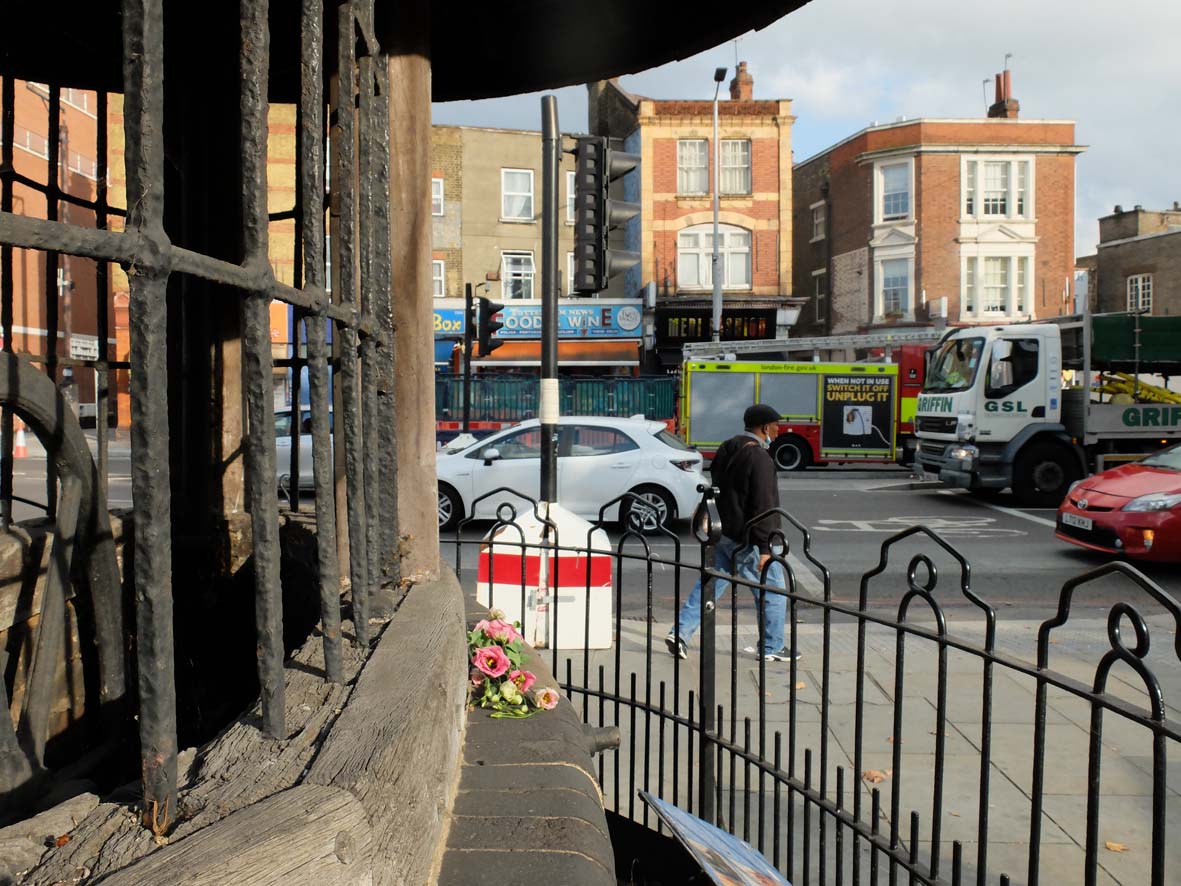
An easy to miss landmark, ‘The Old Well’ in Tottenham was dug into a formal street pump in 1791. Enclosed by railings, and topped with a conical tiled roof, its oval brickwork surrounds the wood and iron structure. It is an odd part of the street scene. The wheel is still visible, which once cranked the production of water through a spout. It sits at a busy junction of the A10, an ancient thoroughfare, known in Roman times as Ermine Street.

In medieval times there was a wayside cross, which is still marked by ‘Tottenham High Cross’. Holy Trinity church, a war memorial, and the town hall are part of the religious and civic landscape. The church sign-board’s invitation is to “join us for a feast of word and sacrament”.

The well is long unused. The only flow visible today is of traffic. A noisy grumble fires up at each change from amber to green. Idling engines create the delicate scent of fuel in the air. People talk in myriad languages, into phones as they walk past. The faces of dilapidated buildings wear grime and peeling paint. ‘Confidence Money Transfer’, ‘City Christian Stores’, ‘Meri Fashion’ proclaim their hopes.

I offer flowers at the well. This is my sacrament, and I offer my simple words of thanks. It feels like a gesture out of time, at a forgotten place. It is a small token to honour the water that gurgles beneath the city.

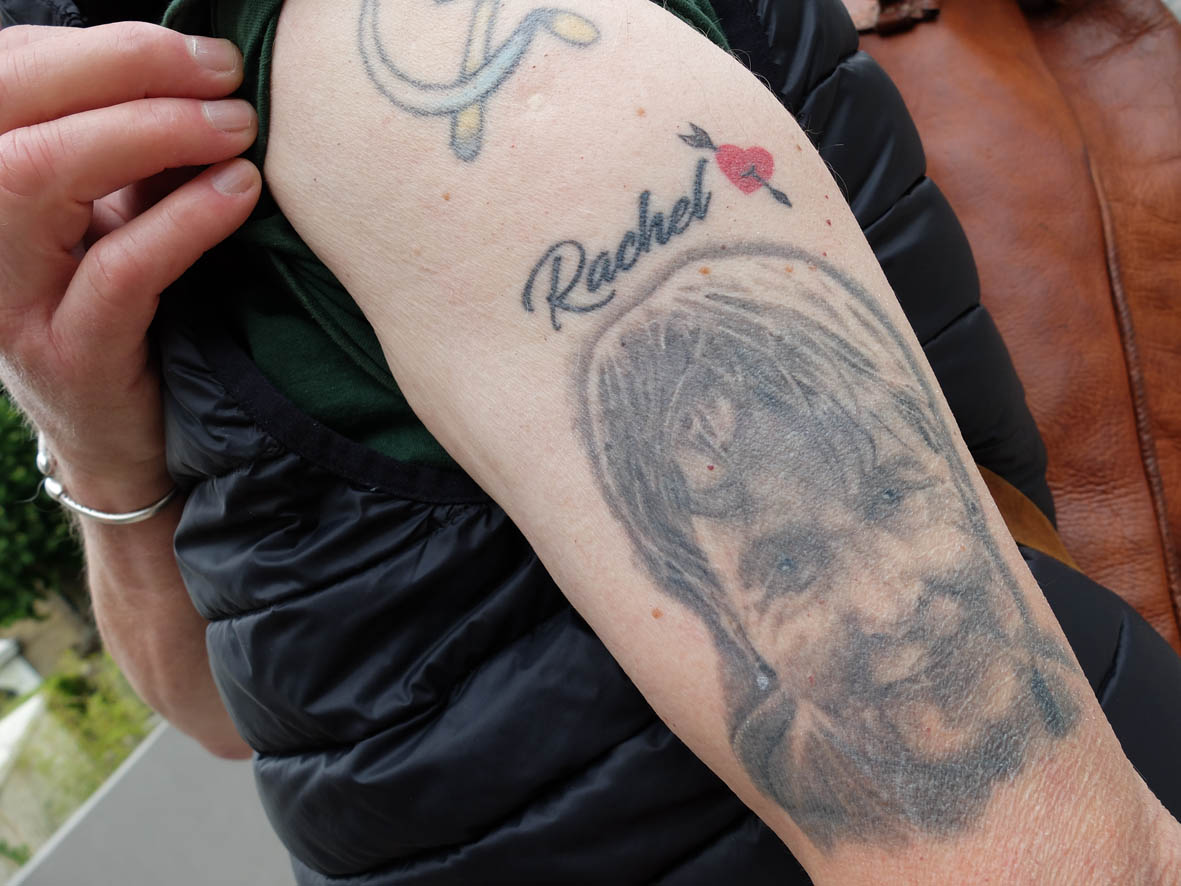
Rachel, who died last year, is commemorated just under a hammer and sickle, and opposite an ‘Om’ sign. At first Bob kept a coffee table memorial with a photograph and flowers to honour his beloved of many decades. The walls are still alive with some of Rachel’s paintings; and on the mantelpiece, photographs hark back to her wilder days of travel, and radical politics alongside Bob.  She still remains close to his heart, on his left bicep. He has also commissioned a local potter to make a plaque for the garden wall. This will continue their tradition of non-conformism, as a non-religious way to remember her life, and the important place she held in their family. For many of us, there is no longer a set way to remember those who have died. We can choose our own ways to mourn, to mark each significant date, to make space for our responses to the absence of loved ones. I love Bob’s characteristically thoughtful approach – a tattooed portrait, as a significant way to mark the pain of his loss, and the plaque to make a dedicated place to remember.

I travelled outside my territory for work. I had time to spare, and drifting, found myself in the neighbourhood which was home thirty-five years ago. Street names began to shake loose from my memory – Pagnell Street, Trundleys Road, Cold Blow Lane. The open square of sky that I loved in the park is still visible. But the map logged in my mind is now tessellated with modern brick-built blocks. Play areas and landscaped amenities now spread where unmanicured industrial spaces used to be. The young adult me encountered sub-cultures of all kinds in Sanford Walk. It was my first experience of living in community. The end wall of the housing co-operative was slowly marked out and painted by mural artist Brian Barnes. ‘Riders of the Apocalypse’ – with its images of Thatcher and Reagan riding war-heads, is faded but still here. Today I met two friendly people from a new generation of community-builders, who welcomed me – a time capsule from 1983. I search my memory for lost fragments of my history. In those days I tinted my hair pink, wore a ‘bib’n’brace’ with DM Boots, painted cartoon images, made vegetarian lasagna and bought 12” singles. Trains rumbled past my mint green bedroom window. Commuters looked in to see strawberry-icecream pink walls. My house mates were worldy-wise lesbians. I was naïve and optimistic, but emotional jelly inside. The losses and joys since then have shaped me, and standing here again I can feel the distance I have come. My sexuality is no longer a mystery. I am still living in queer community with people who share a sense of indignation at the injustices in the world.

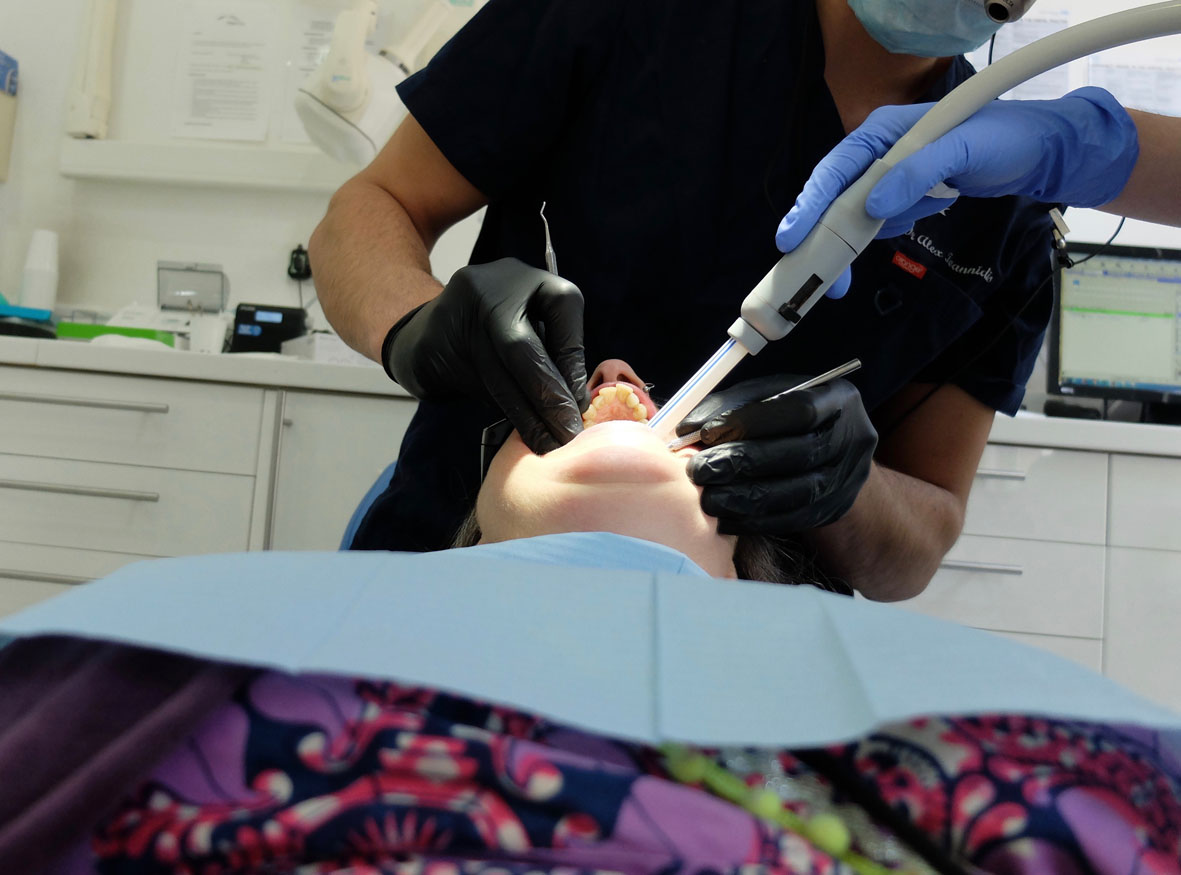
“You really look after your teeth”, were the muffled words from behind the mask. “I need to”, I think but don’t say, as I reflect on my complex dental history. I am extremely grateful to this unfamiliar dentist who is peering at the hole in my mouth where a crown has been dislodged. A sharp edge on the remaining fragment of tooth is lacerating my tongue. He wrestles to fit a metal clamp over my tooth in thick black latex gloves. I would smile if I could at the choice of pink dental dam. I am lucky. Not only does my dental practice have an emergency clinic during the ‘shut-down’, but this particular dental problem does not require an ‘aerosol generating procedure’, ie drilling. Tooth drilling is only to be carried out in the most extreme emergencies according to the latest government guidelines. I recommend spending the extra time to brush behind that wonky molar, to floss or use a tee pee. This dentist anticipates that routine dental care is unlikely to be available for months ahead. I shall be nibbling carefully next time I eat a piece of rustic toast, and will brush diligently afterwards.

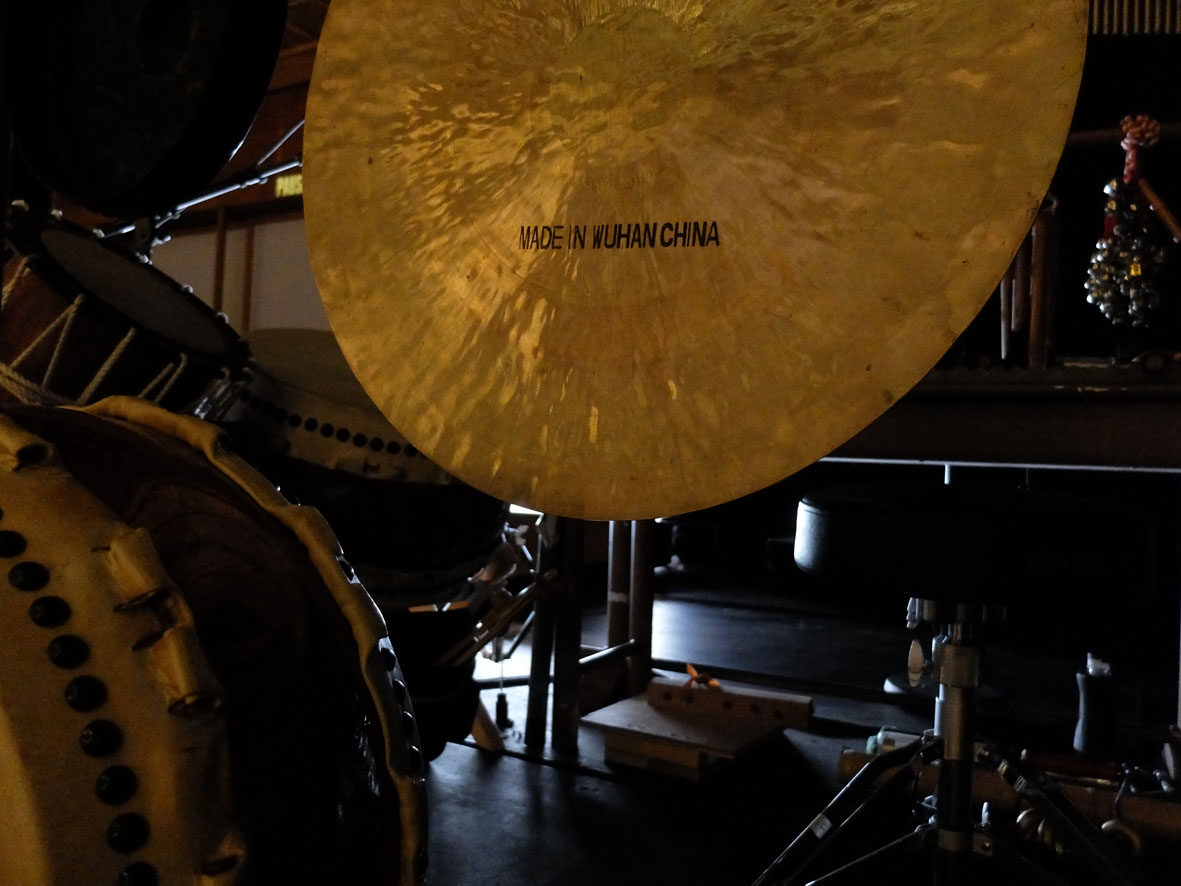
Before the theatres went ‘dark’, I was lucky enough to spend seven hours immersed in Robert Lepage’s visionary epic, ‘The Seven Streams of the River Ota’ at the National Theatre. This is a revised production of the work, created by Ex Machina – Lepage’s multidisciplinary company. Robert Lepage is an extraordinary magician, with a creative team who bring together performing with recorded arts to make extraordinary theatre. Seven scenarios take place within the piece, from 1945-1995. There are elements of overlapping narrative. “Hiroshima, city of pain,” is where the arc begins and ends. One after another clever and beautiful image takes us through the different scenarios. The action depicts Hiroshima post nuclear explosion, close proximity of relations in an American boarding house, life in Theresienstadt concentration camp in Czech, a farce in Osaka, (shown both from the inside and outside), diplomatic life in Osaka, an assisted suicide as a result of HIV Aids in Amsterdam, and Hiroshima again. Sometimes the narrative is more obscure, but ultimately the whole piece is devised to show Hiroshima as a symbol of rebirth. Within the play there is also an exploration of theatre itself, and its ability to transform details of history into a felt understanding. With his usual inventive flair, physical performances blend with lighting, video and sound to summon atmosphere and emotions. These draw me in to each character’s different history of trauma and grief. Looking back to a day when there were only 163 confirmed cases of Covid-19 in the UK, the few empty seats appearing in sold out shows offered bargain theatre-going opportunities. My elbow touched a stranger. Recalling breath-taking tableaux summoned up with light, silhouette, colour, mirrors, dance, humour, story, sound and silence, conjures up illusions within what now seems an illusory time. A garden of stones creates a walkway to be kicked up with butoh, or walked on through the opening sequence. Percussion adds to the crunch. One and sometimes two drummers keep the show moving. I notice the cymbal “Made in Wuhan China”. It reverberates, calling our attention to find meaning in a sea of grief.

Ex Machina, the company of Robert Lepage

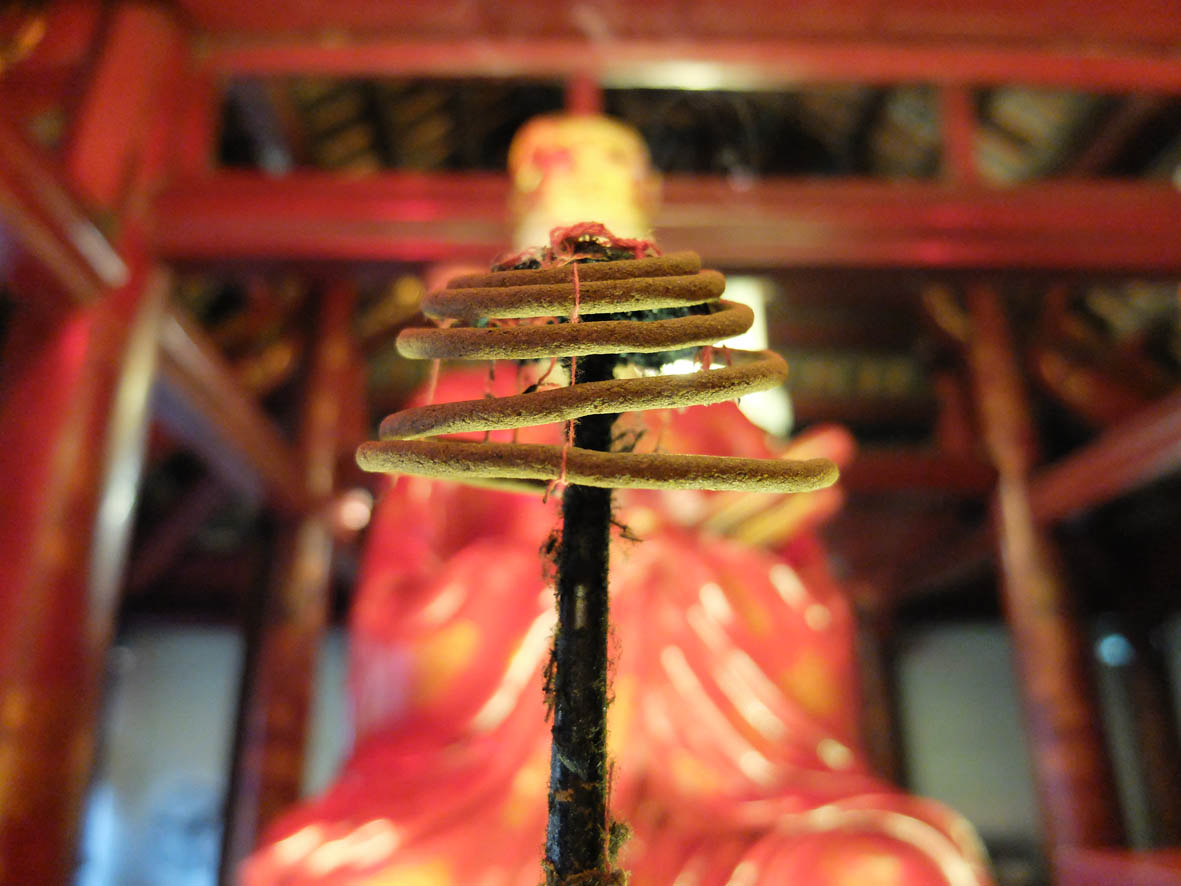
We have recently come from a village where each family makes incense. I remember the dark room with a fire that scents each fist of incense sticks with lingering wood smoke. Through a doorway on the street we walk into a temple. Here is a coil of incense burning on an altar. It burns before a statue, the image of a teacher or temple guardian. Temples lie behind the street facades. A parallel world exists behind the financial exchanges of cafés and shops. These red and gold shrine rooms offer a different kind of exchange. A stick of incense, piece of fruit, bar of chocolate or can of beer is offered. These gifts are to give thanks, and the giver asks in return for a blessing. This particular statue, may be an unknown teacher to me, but a little gratitude feels necessary. Today, we are all alive and well. We have much to be thankful for. It feels important to be in right relationship with ‘the unseen’. I bow my head, light incense, give thanks, say a prayer and ask for my own blessing. We may be away from home, but hope that our ancestors and guides are with us on our journey. I trust they are keeping a protective eye on us.

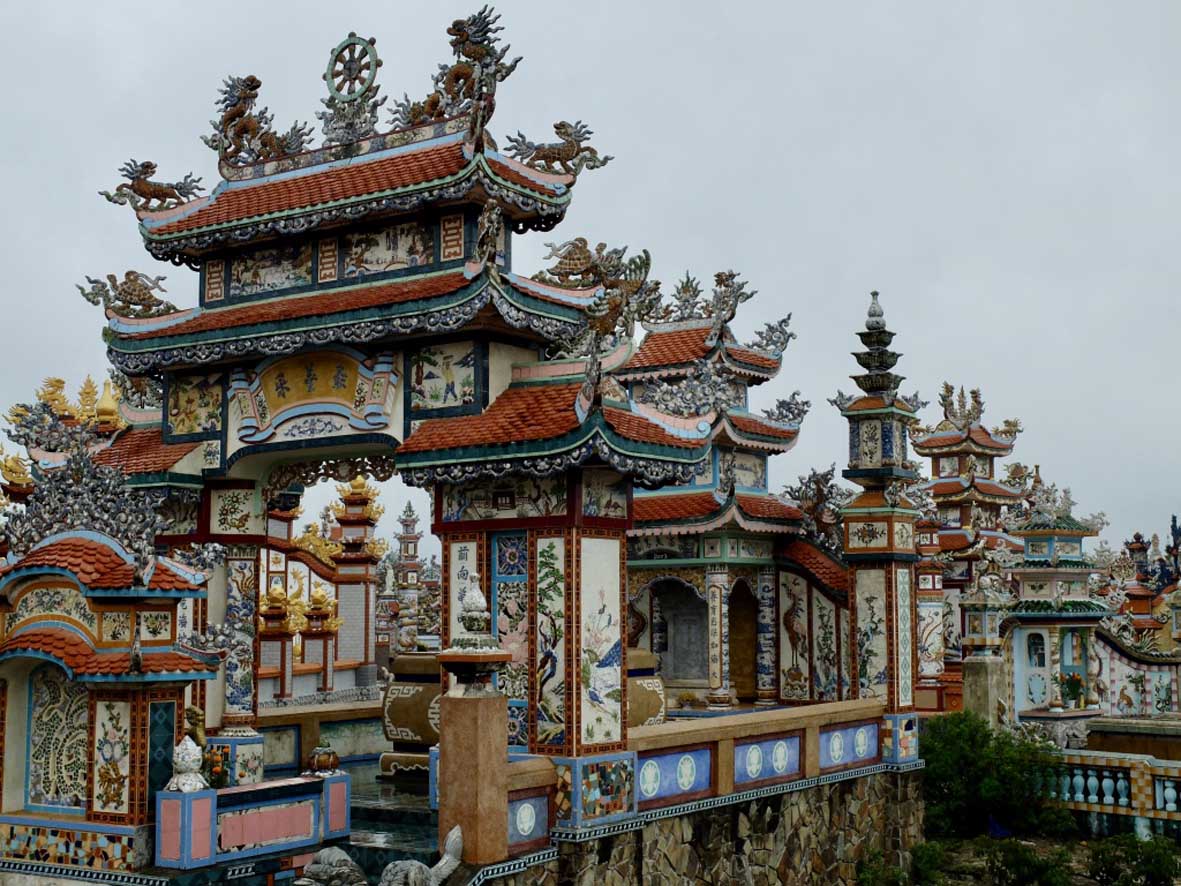
Forty five minutes outside Hué, (the old capital city of Vietnam), lies another city. ‘The City of Ghosts’ is not inhabited by the living, but the dead. It is an eerie and extraordinary place. We have already passed war cemeteries with uniform graves, cemeteries full of tombs decorated with cement curlicues, rice paddies with a small family tomb in the centre, and large gated roadside family tombs. This, however, is in another league. The City of Ghosts boasts family mausoleums in a bigger league. The grandeur, ambition of construction and decoration super cedes most houses. These multi-coloured mosaic tombs are now rumoured to be costing up to $300,000. Set on a beach, built with concrete on sand, the layout of plots is un-gridded. Unlike the meticulous division of paddy fields and farmed plots, the edge of each mausoleum randomly butts up against the next, without formal pathways. I am told that refugees exiled as ‘boat people’ in the 1970’s, no longer able to return, send money from western incomes to older family members who save for these grand memorials. The designs represent the faith, décor and architectural styles of their patrons. There are Buddhas, Confucian symbols and crosses. Some are themed in blue and white – willow pattern style. A Virgin Mary is nestled in an alcove. There is a Vatican shaped cupola. Dragons and bears guard doorways. While family gatherings to remember ancestors are an essential part of life in Vietnam, there are few signs of life as we scramble around endless memorials in the rain. It is definitely one of the most incredible places I have ever been, and it made me feel strangely uncomfortable and empty.

As a child, on Christmas Eve, my father produced a cardboard box from the attic filled with wooden shavings. Hidden underneath were small glass baubles. Each one was scratched, with wire fixings that had a tendency to break. We had a set of fairy lights with small tasselled Chinese lanterns on each bulb. Their seasonal arrival, and exquisite detail fascinated me. They would work at best intermittently. In the corner of the vicarage living room we dressed a tree with these and balding strings of silver tinsel. An angel cut out of metal with sharp treacherous wings would be precariously placed on top. Presents, family, food and Christmas Specials on BBC1 had to be fitted around my father’s church work schedule, and my mother’s general state of mind. When other households were sitting down to eat or watching the Queen full of sprouts and turkey, we might be eating a bowl of soup; but then eat a special dinner much later. I enjoy the concept of a Victorian idyll, as long as it’s optional. An unexpected gift came today from our generous local creative florists, so now we have some traditional greenery to acknowledge the season and it brought with it some genuine Christmas Spirit.
www.jcmeades.co.uk