
Author: admin

Poppy in full bloom to represent the flourishing of Grief Tending.

We have been collaborating with Sophy Banks of Grief Tending in Community to track the way that Grief Tending is flourishing. It is becoming more widely known, and spreading geographically. Many more people are offering the practice and there is a growing number of people who have attended one or more Grief Tending workshop, ritual or event.

Introduction to Grief Tending Audit

Grief Tending in community is a practice that involves a group of people coming together to share grief, with space to express their emotions. It can be a life-affirming experience and in addition to providing support and relief for current grief, can help people learn skills to cope with grief. Grief Tending events including a range of practices: simple exercises for participants to build trust, group ritual to express and witness feelings, embodiment to regulate the nervous system.

In Grief Tending events, all kinds of grief are welcome. We honour loss, absence, longing and change, and reconnect with intimacy and belonging. Grief tending is rooted in the teachings of Sobonfu and Malidoma Somé, Joanna Macy, Martín Prechtel and others, and has been shaped by teachers including Maeve Gavin, Francis Weller and those in this network.

Grief Tending events take place in a variety of face to face and online settings, including: an existing community, a group of people who come together temporarily, and a group who meet regularly.  Each Grief Tending event is facilitated by Grief Tenders.

In 2024 a preliminary audit was undertaken of Grief Tending events in order to observe and record the range and diversity of current practice

Audit Methods

Grief Tenders recorded and shared information on their face to face and/or online events. Information on the date and length of event and numbers of facilitators, assistants and participants was recorded in an online spreadsheet. This information was then summarised.

Note that we recorded the numbers attending each event. Some will be returners, so the total number of people who have attended events is less than the number shown here. We estimate that between 10 – 25% of people have been to an event before.

Results Show Grief Tending is Growing

Eight Grief Tenders shared information on 225 events held between 1/12/2013 and 31/12/2024, where grief was shared and witnessed. In total there were 3066 people attending (including a total of 720 at two festivals in 2023 and 2024). Participants joined from all continents (except Antarctica), the majority from the UK, followed by Europe and the US and Canada.

The number of Grief Tending events increased over time. The duration of both face-to-face and online events varied widely.

There were multiple short online events – some lasted 1 hour others 4 hours and others were all day or over multiple days. The longest online programme is the Apprenticing to Grief, which runs over 3 weekends.

The duration of face-to-face events varied from one or more hours, to workshops which ran over four days, and the Apprenticing to Grief over six days. Most face-to-face events lasted for 1 day or 3- 5 days.

All events (online or face-to-face) were led by a Grief Tender and supported by at least one other Grief Tender, facilitator or assistant.

Developing our Research

We believe this to be the first audit of Grief Tending events. Some participants have taken part in more than one event, so the total number represents workshop spaces attended. The number of unique people who attended is estimated at around 80% of this figure. Some figures provided by facilitators are estimates based on average numbers attending workshops.

Our initial objective in gathering this data was to sense the impact and reach of this network. In 2025 we aim to gather more comprehensive information from more people who are holding spaces. We would also like to see what else has resulted from attending the Apprenticing to Grief programme.

Many of us holding workshops gather evaluation information at the end of a workshop, or invite this feedback from participants online afterwards. We believe Grief Tending in community to be a low-cost, high impact intervention to improve mental wellbeing of those impacted by bereavement, loss, past trauma, stress, and life changes. We also believe it can have beneficial effects on those around people who come, which would be harder to measure. We would like to understand more about the impact of these practices on those who have attended Grief Tending events. We are exploring the best methods for doing this e.g. a survey of people who have attended.

Thanks to all those who shared their data, and all of you who are helping this vital work to spread to those who may need it.

You can find Grief Tending workshops with the Embracing Grief Team in London, Devon and online here. For the Apprenticing to Grief programme online or in person see here.

Sarah Pletts is a Grief Tender and Artist who offers workshops in London and online, sharing rituals where grief on all themes is welcome. For more information about Grief Tending see www.griefsupport.org.uk .

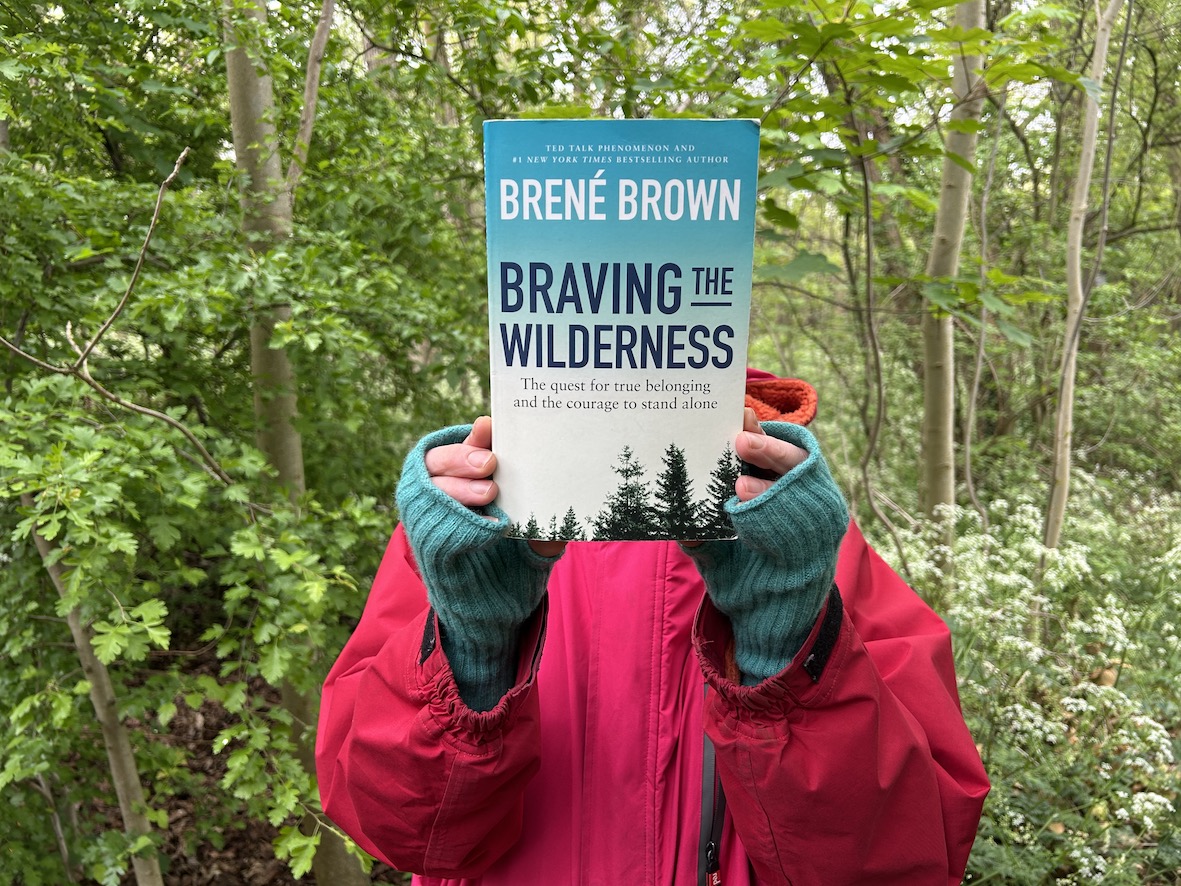
A review of 'Braving the Wilderness' by Brené Brown by Sarah Pletts

‘Braving the Wilderness’ is a gem of sense-making by Brené Brown. She extrapolates from her detailed research to illuminate cultural patterns of behaviour. In this book, she takes on belonging, and in its absence, “the lonely feeling”. With her signature Texan flavour, she communicates how to make brave choices to speak out and be courageous.

Brené Brown shot to fame with her Ted Talk ‘The Power of Vulnerability’. She has continued to study vulnerability along with its relatives, shame, empathy and courage. The full title, ‘Braving the Wilderness: The Quest for True Belonging and the Courage to Stand Alone,’ speaks to the resilience necessary to be true to yourself, in the face of resistance. How do we speak truth to power, defend our values, advocate for what we believe in?

Learning from her research subjects, Brené Brown has put together a guide for navigating through differing opinions to risk not fitting in, in order to find true belonging. While the book is about leadership and belonging, it offers pathways to repair collective grief.

The steps in ‘Braving the Wilderness’, from the evidence-base suggests, read like a recipe for Grief Tending.
>“We’re going to need to intentionally be with people who are different from us. We’re going to have to sign up, join, and take a seat at the table. We’re going to have to learn how to listen, have hard conversations, look for joy, share pain, and be more curious than defensive, all while seeking moments of togetherness.”

Building connection across difference, through sharing vulnerability and joy is how we bridge love and loss, grief and praise. Being willing to do this takes courage.

She identifies steps to risk vulnerability and find belonging. Joining with others to celebrate with food or music is an essential ingredient. Working with gratitude helps to grow joy too. Brené Brown’s conclusion:
“The answer that emerged from my research shocked me. Show up for collective moments of joy and pain so we can actually bear witness to inextricable human connection.”

First published in 2017, ‘Braving the Wilderness’ predates the exponential growth of culture wars, the proliferation of certainty and polarised debates. (For a background history on culture wars, listen to Jon Ronson’s ‘Things Fell Apart’.) Collectively, we would do well to pay attention to Brené Brown’s findings in order to navigate these times.

If you would like to experience how vulnerability builds connection through Grief Tending, you can find workshops in London, Devon and online here.

Sarah Pletts is a Grief Tender and Artist who offers workshops in London and online, sharing rituals where grief on all themes is welcome.  For more information about Grief Tending events see here

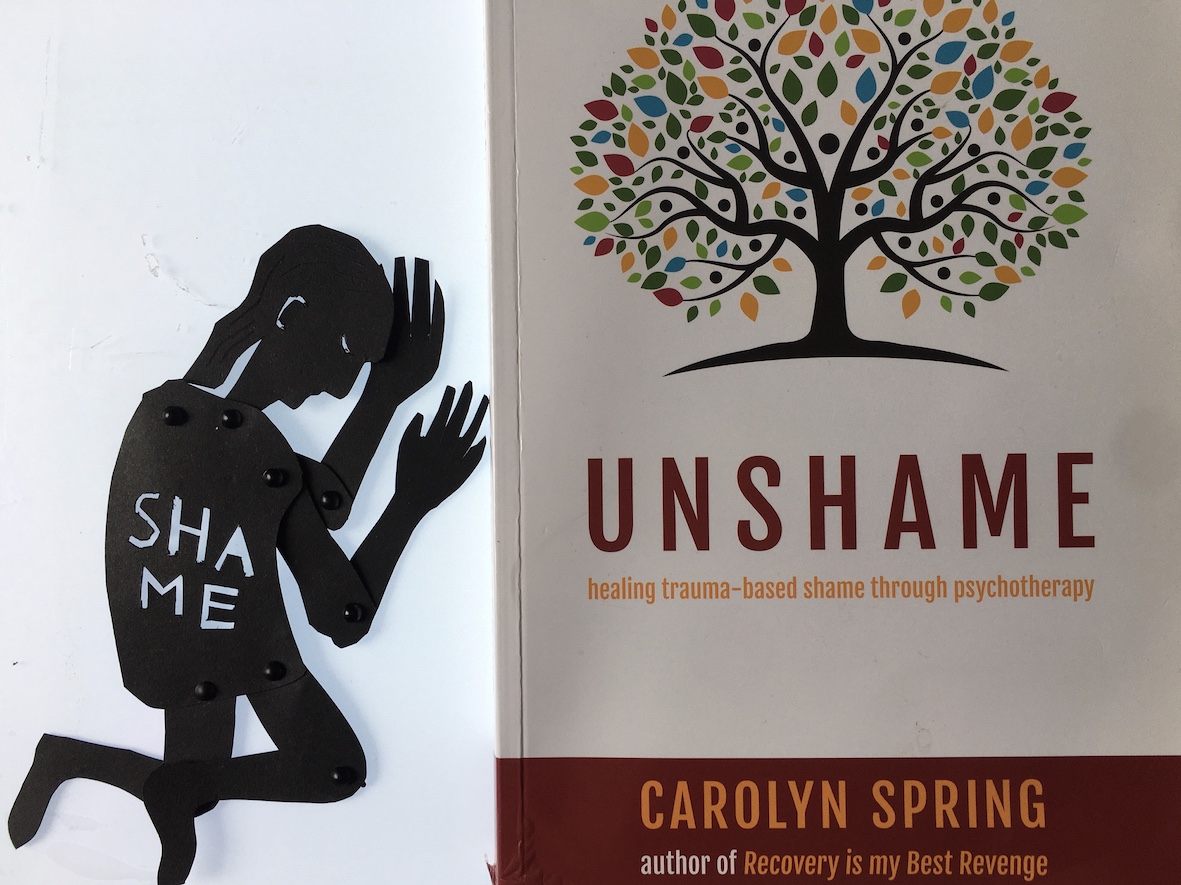
Review of book 'Unshame' by Carolyn Spring and shame shadow cut-out by Sarah Pletts

‘Unshame’ is the name of a book by trauma survivor and educator Carolyn Spring. Unshame might be used as a verb which describes the process of repair from chronic shame. It could be an adjective to describe being unashamed without the judgement associated with ‘shameless’. It might also be a noun for the healthy place where trauma-based shame is no longer a persistent and toxic state of being.

Carolyn Spring describes her own complex trauma history which left her mired in shame. As a result of child sexual abuse, she was left with multiple dissociative traumatised parts. ‘Unshame’ describes her slow recovery. It includes an in-depth exploration of the experience of shame in therapy. She tells much of the story from the inside out, how it felt and seemed in her mind and body.

Shame is a feeling that exists in relation to others. “Shame is a two-person emotion”, as Carolyn Spring puts it. Recovery from shame also by necessity happens through relational connection. Shame is about our self-worth, and is very different to guilt which may be an appropriate response to wrong-doing, which spurs us to make amends.

Carolyn Spring’s writing (and trainings) take the mechanisms of trauma survival apart. The survival strategies that operated to drive dissociation, and take on her abusers’ shame as her fault were “the best thing you could do at the time to survive.” Using direct language, she explains how it feels. And she describes the way brains and nervous systems operate under extreme stress.

Using her own experience, Carolyn Spring shows us how shame operates. Shame feasts on secrecy and may leave people feeling that they are to blame for the abuse they experienced.
“No one wants to hear it. No one wants to know about it. No one wants to feel it. So I have to hide it and hide it, and I have to push it away deep down within myself, so that no one can see. But it doesn’t go away and it doesn’t stop affecting me…”

Shame is sticky and a shame attack often comes with acute physiological symptoms. It is a physical as well as mental and emotional ride. It is commonly present for those with developmental trauma, and people who are or have been in abusive situations, amongst other things. In order to bring relief, Carolyn Spring documents the slow, gentle, patient presence of her therapist. As well as the light of day, unshaming requires right brain to right brain co-regulation. Carolyn Spring shows how dissociation is also tackled with mindful noticing, unconditional positive regard, and relational connection.

The pain and suffering of toxic shame and dissociation is made more lonely by isolation. Through telling her own story, Carolyn Spring makes a passionate case for finding spaces where trust, presence and respect enable revelation and ultimately healing. Often in Grief Tending we may see how others also share some of their inner experience of shame, which may be a relief to us.

Reading ‘Unshame’ may be the first step in acknowledging and naming chronic shame. I also recommend the book as a manual for those who aim to provide compassionate holding for those who are making the journey from shame to unshame.

For Grief Tending events online and in person in London and Devon see here.

Sarah Pletts is a Grief Tender and Artist who offers workshops in London and online, sharing rituals where grief on all themes is welcome.  For more information about Grief Tending events see here

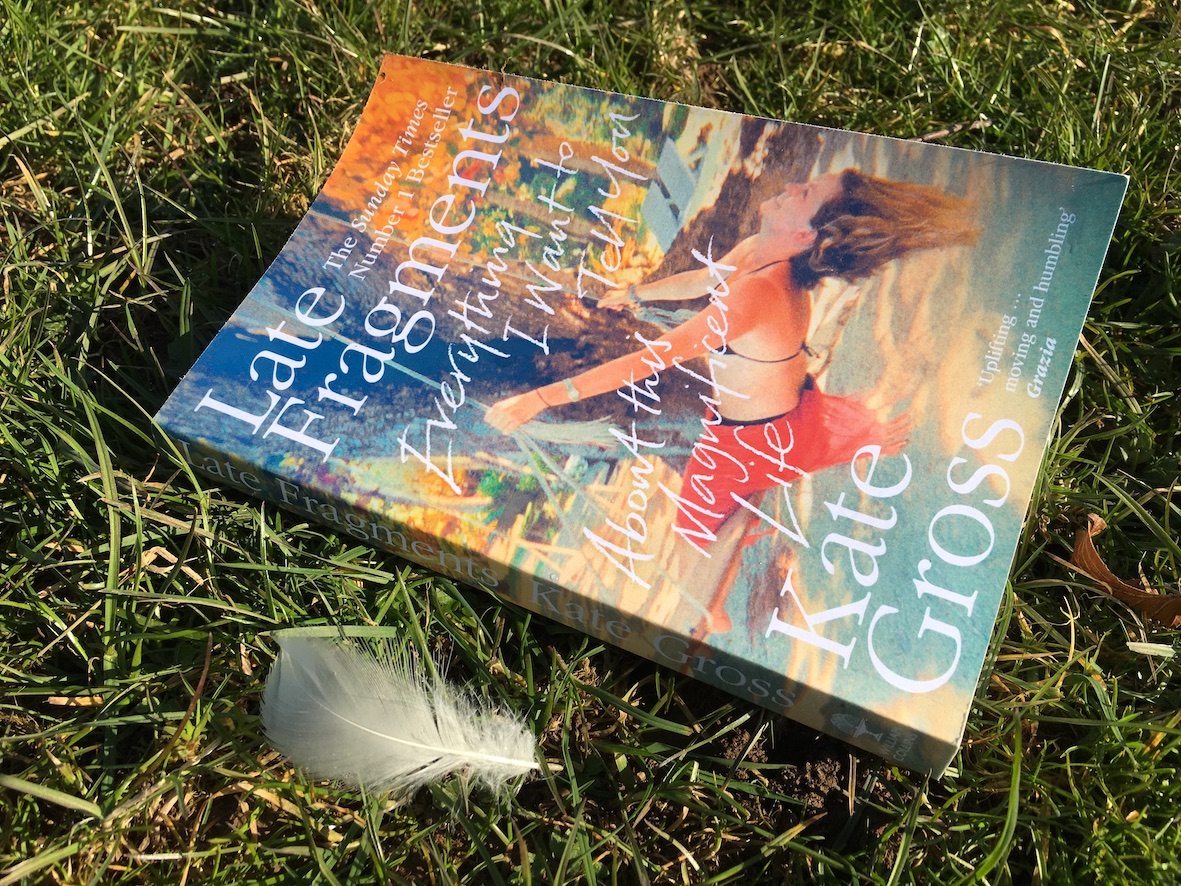
Image of 'Late Fragments' book, shown here on grass with a feather to represent life's temporary nature.

‘Late Fragments’ by Kate Gross is written from the lens of a terminal cancer diagnosis. I read books that take me into this life-affirming territory because they make me tingle. I suspect I guzzle mortality memoirs in the way others read chick lit. In her own words:
“I know that people will want to read my story because it takes them to the edge of their fears about dying young, leaving the people who need them.”

Kate Gross describes her triumphs and failures as she approaches her death. She speaks of “our future that melted away overnight.” For those who know Francis Weller’s Gates of Grief, this loss of future is a clear example of ‘What we expected and did not receive’. The imagined readers – her children in years to come, set the tone of the book’s intention. Through writing she manages her living time, and plans her dying time.

Like any ‘momento mori’, this reminder of death is also an invitation to live with eyes open. These ‘Late Fragments’ are written to capture and to encourage us to find wonder. When the outer activities of life are stripped away, and we slow down, can we also enter into the realm of wonder?
“All I can do is explain how wonder emerged for me as the world and I met, and how it has grown stronger and brighter even as my world has got smaller and dimmer.”

‘Late Fragments’ is not written by an expert on cancer, or on grief. It is an engaging personal account from the front line of a terminal diagnosis of colon cancer. It is packed with cherished memories of friends and family. The life Kate Gross describes is both worldly and ordinary. Time is spent on the sofa, in parenting and includes words like ‘bum’.

In fact, I was horrified that because of a reluctance,
“to speak of our rear ends, most colon cancer is detected between stages two and four,” with detrimental consequences. So, I encourage us, in honour of Kate that we challenge the inhibitions that delay us from checking our bowel movements and symptoms that may be warning signs.

Kate Gross also speaks for the person-who-is-dying’s needs for the kind of communication that comes with sensitive offers and ordinary chat, without advice-giving, or the need for a reply. Our own anxiety or desire to do good can burden the person already dealing with much into taking care of others’ emotional needs.

Lines from poets and author’s, are woven into ‘Late Fragments’. Kate Gross’s passion for words enlivens the narrative. She uses them to inspire and illuminate the steps of her own journey towards death.

To find Grief Tending workshops online and in London and Devon, see here.

Sarah Pletts is a Grief Tender and Artist who offers workshops in London and online, sharing rituals where grief on all themes is welcome.  For more information about Grief Tending events see here

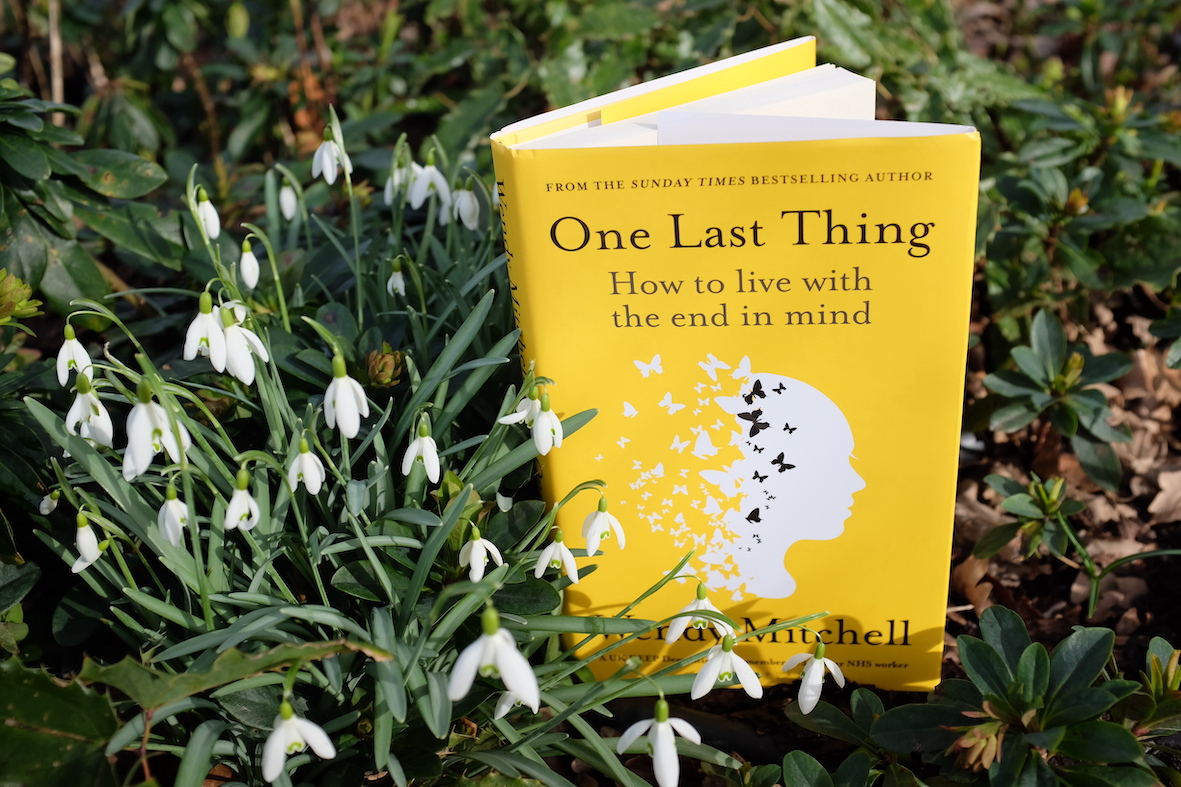
Image shows the book 'One Last Thing' by Wendy Mitchell in a landscape with snowdrops.

‘One Last Thing: How to Live with the End in Mind’ by Wendy Mitchell is written from the inside of a life-limiting condition. She was diagnosed with early onset dementia at 58. Since then, she has written three books about her journey of life post diagnosis.

Mitchell writes with down to earth good humour, giving us an insider’s perspective of this unkind progressive disease. Dementia dismantles the life she had before, yet she is full of optimism about what is still possible to achieve. She is inventive in the way she adapts to the challenges. It is powerful to hear her voice which brings understanding and hope to others navigating dementia.

“I am aware that there is an edge now, even if I cannot see it as it comes closer. I am aware that more days after I finish writing will be spent in the fog – until the day when I don’t find my way back out again?”

In ‘One Last Thing’, she contemplates death in her characteristically practical way. Wendy Mitchel is a passionate advocate for those with dementia. She checks for judgements and assumptions that diminish the potential of people with the disease. Mitchell is also pragmatic about the paperwork and decision-making to be done. There is a great deal of ‘sadmin’ as she looks death squarely in the eye. She encourages everyone to have honest, thoughtful conversations. This is especially important in preparation for end-of-life in order that people may make their preferences known.

“I am not trying to tell you how death must be done, or how it should be done, or how it should feel for you. I just want to gently remind you that one day it will come, and the more prepared you are, the more conversations you are able to have with medical professionals and with those you love, the more empowered you will feel to live in the now – and you don’t need a progressive or terminal illness to do that.”

Wendy Mitchell recommends really thinking about all the options for a good death. This in order that people, especially those with dementia are able to have choices, and agency in those choices while they have capacity.

‘One Last Thing’ tells Wendy Mitchell’s relatable story, and she demonstrates how it is possible to be brave, sensible and kind as she turns towards her own ending.

Post Script

Since the publication of the book, Wendy has died. She did it in the way that she chose to on 22 February 2024. If you want to know more, and this may be a plot spoil, head to her final blog post.

If you are looking for somewhere to process grief of all kinds, you can find Grief Tending workshops online and in London here.

Sarah Pletts is a Grief Tender and Artist who offers workshops in London and online, sharing rituals where grief on all themes is welcome.  For more information about Grief Tending events see here

'Grief Is for People' Book shown here with a jewellry box which relates to the first chapter of the book

Sloane Crosley is a metropolitan New York wordsmith, author of ‘Grief is for People’. It is an exploration of the ways different forms of loss and absence take hold in her life. It begins with a jewellery cabinet.

She uses original metaphors, relishing in language.
“But the trauma humps my leg like a dog. I pick at memory scabs, recalling the sound of the amber amulet sputtering along its chain.”
Familiar with the literary sphere, she echoes and sometimes quotes from Joan Didion’s writing.

Crosley paints a detailed portrait of a close friendship. She describes the holes left behind in its absence; the way another’s death can take our history along with it.

I enjoyed its portrayal of the impacts of death and loss that happen in myriad ways in ordinary lives. It took me into an unfamiliar city, and the professional and sometimes funny world of agents, publicists and writers. This setting is itself in transition as she writes through pandemic, and other gathering forces – like social media and AI.

It is not a dramatic memoir of traumatic partner or child loss. It is, however, valuable to describe the loss of a close friend. This will inevitably happen to us all over and over again as we age.

‘Grief is for People’ is not a how to guide for facing loss, but it may ring a chord if you are melancholy or haunted by what has gone. Crossley examines the interplay between past and present.“I have read the grief literature and the grief philosophy and, God help me, listened to the grief podcasts, and the most practical thing I’ve learned is the power of the present tense. The past is quicksand and the future is unknowable, but in the present, you get to float. Nothing is missing, nothing is hypothetical.”

Grief Tending workshops are for people processing loss, absence and change and not just bereavement. You can find events online and in London here.

Sarah Pletts is a Grief Tender and Artist who offers workshops in London and online, sharing rituals where grief on all themes is welcome.  For more information about Grief Tending events see here

The book 'The Year of Magical Thinking' shown here in a hospital setting to reflect content

Joan Didion is an articulate writer, with enough resources to assume that she can control her life. In ‘The Year of Magical Thinking’, she is knocked by the reality of grief and the bewilderment it causes, as she finds her way through new circumstances.

‘The Year of Magical Thinking’ is worth reading. She describes books on grief as “a body of sub-literature, how-to guides for dealing with the condition, some “practical” some “inspirational”, most of either useless.” This book is not self-help, but realistic, and written with enough vulnerability to be inspiring. She uses her writer’s craft to turn a mirror on her experience of sudden loss.
“You sit down to dinner and life as you know it ends.”

Didion examines the skips and foibles of her cognitive process (a normal part of the experience of grieving). She is a keen observer describing the liminal place of the recently bereaved.
“I myself felt invisible for a period of time, incorporeal.”

We see ourselves entitled to a fair portion of trouble, but grief does not land in people’s lives equally. In ‘The Year of Magical Thinking’, Didion writes through a double portion.

I read books on grief, not just because I have a professional interest in them, but because I too have a magical thought process that predicts that if I learn enough about dying, each new loss will be easier.

“I realise how open we are to the persistent message that we can avert death,” Didion says. My own curiosity is itself part talisman to ward off mortality.

See Grief Tending workshops for grief of all kinds online and in London here.

Sarah Pletts is a Grief Tender and Artist who offers workshops in London and online, sharing rituals where grief on all themes is welcome.  For more information about Grief Tending events see here

'Earth Grief' book shown here in a landscape of rolling hills to reflect the theme of nature.

Reading ‘Earth Grief’ by Stephen Harrod Buhner was for me an experience of being in the feelings evoked by the territory of ecological loss. It begins with a dive into being earth. He uses the language of connection, rather than evoking the separation so common of science.

As the pages turned, I was engaged, disturbed, then relieved, concluding with a deep sense of peace. Stephen Harrod Buhner’s invitation is to step into the painful reality of receiving a collective terminal diagnosis. He describes:

“…the grief, pain, depression, and hopelessness we feel are not the problem (despite the soul-shattering impact of those feelings). They are symptoms of the problem. And it is the problem itself that we must face if we wish to address the crisis of our times…a crisis that exists out there in the wildness of the world as well [as] in here in the secret chambers of our own hearts.”

Like Vanessa Andreotti’s ‘Hospicing Modernity’, really opening to hearing the words in ‘Earth Grief’ takes courage. Yet the wisdom and truth-telling I found here also felt settling. I chose not to read the middle section at night. Instead, I titrated my way through felt but not often absorbed information. It is distressing and affecting to read of the irreversible impacts of micro-plastics, of pharmaceuticals, of extractive and exploitative industries. My strategy was to read the book in manageable doses with lots of resourcing.

Through the analogy of the personal loss of a beloved, Stephen Harrod Buhner guides us through a similar process with grief for the earth. He describes the dismantling of our inner world in the face of loss, and the slow process of transformation.

In ‘Earth Grief’, Buhner challenges the layers of denial that I cling to in the face of what is happening in ourselves, in our climate and in our planet. As with the work of ‘Deep Adaptation’, there is potential for joy, wisdom, purpose on the other side of feeling earth grief.

Humans are returned by Stephen Harrod Buhner to their rightful place as reciprocal beings with plants – whose extraordinary journeys over millennia breathe life into our world as we flounder. This is a reminder of interbeing in a more-than-human world, that humans too are of the earth, not above nature. For me this is a reminder of David Abram‘s writing.

If Earth Grief is the diagnosis, a shift in perspective to find collaborative connections with other plants and beings is necessary. Grief practices that tend without fixing are the medicine. When we allow grief to take our world apart, to grow and re-configure us, we become able to hold others, and find what is uniquely ours to do.

Grief Tending spaces welcome grief on all themes, including earth grief. We offer events online and in London and Devon.

Sarah Pletts is a Grief Tender and Artist who offers workshops in London and online, sharing rituals where grief on all themes is welcome.  For more information about Grief Tending events see here

The speakers who feature in the interview described here are shown. 'Embracing Grief' Team.

Watch ‘Embracing Grief: The Power of Witnessed Grieving’ on the Dandelion podcast.

Stephen Reid interviews Bilal Nasim, Sarah and Tony Pletts about their Grief Tending events. Here’s what he says about our conversation:

“Drawing on the work of people including Malidoma Somé, Francis Weller and Joanna Macy, Embracing Grief offers group ceremonies and workshops that create brave spaces for people to explore personal, collective and ancestral grief. The facilitators emphasize that grief work isn’t about “fixing” anything, but rather about creating welcoming containers where all emotions – from numbness to anger to joy – can be safely expressed and witnessed.

One of the most surprising aspects of grief work, according to the facilitators, is just how much joy, connection and even playfulness can emerge when grief is given space to move. They offer various formats from 4-hour online circles to full weekend in-person workshops, making this vital work accessible to different needs and comfort levels. The team is gradually expanding their capacity by bringing on new facilitators, helping to meet the growing need for collective grief practices in these times.”

Look out for the moment when Bilal mysteriously changes his environment…

You can see more details and book Embracing Grief events on Dandelion.

Sarah Pletts is a Grief Tender and Artist who offers workshops in London and online, sharing rituals where grief on all themes is welcome.  For more information about Grief Tending events see here

Setting shown here with mat that is used for grief ritual, including jug and bowl.

Grief counselling or bereavement counselling usually happens one to one with a counsellor or therapist who specialises in grief. Grief Tending usually happens in a group with a focus on grief. A Grief Tender facilitates a group using exercises, practices and rituals to connect with feelings.

Grief Tending rituals may include symbolic use of elements – such as pouring water. The participants in the group move between roles; to be griever and then witness or supporter. A group comes together with the intention of sharing grief. This act of communal exploration can provide validation of our experience, and help us to empathise with others. Instead of solely being immersed in our own perspective, we see that others also suffer. People may experience connection with the group that grief counselling alone cannot provide. Grief Tending may profoundly alter someone’s sense of isolation.

Individual grief therapy or counselling can be exactly what we need if we are in an acute grieving process, and unable to switch our attention to other people for the duration of a workshop. Grief or bereavement counselling may also offer the support we need before and after a Grief Tending event. One-to-one sessions and group work are excellent complementary ways of working.

There is more time and attention available one-on-one for people to be heard at length, and to go deeply into their experience over time. It can be important that a therapist has specific knowledge and experience around working with loss. Most therapists and counsellors will be happy to answer questions or be available to discuss this at an introductory meeting. Often our gut response or intuition are the best guides for us to identify the therapeutic approach or practitioner that will suit us.

Many grief counsellors use “talking therapy”. This can be a really helpful approach. It may also be beneficial to find practitioners that work ‘somatically’, including the body. One-to-one bodywork can also be really supportive in the wake of loss. To hear more about the differences between Grief Tending and bodywork, watch ‘On Working With Grief’ with Sarah Pletts and Max Mora.

In Grief Tending we bring together different ways to work with grief, and pay attention to the physical – noticing symptoms and sensations, using movement and non-verbal expression, as well as words. As part of Grief Tending, we encourage people to try the tools we offer as part of an enquiry to find out what works best for them.

Working one-to-one with a grief counsellor, joining a Grief Tending event or working with both are all valid. We may need different things at different times when we are on a journey with grief. Grief Tending isn’t grief counselling, but it may partner grief counselling, or be an alternative to it. Sometimes people come to a single Grief Tending workshop, or choose to come regularly. Others come from time to time, when they need the support of a group.

You can find Grief Tending events coming up online and in London here.

Sarah Pletts is a Grief Tender and Artist who offers workshops in London and online, sharing rituals where grief on all themes is welcome.  For more information about Grief Tending events see here