Author: admin

Still from video described showing Sarah Pletts the author of the post with the video presenter

During my 30’s I experienced burnout. I became chronically ill, exhausted and overwhelmed. It took eight years to recover. I had some excellent guides on the way, and was lucky enough to make my way through to the other side. It was my own bespoke journey into the underworld, where I was required to transform my patterns of over-giving, dis-connection between my body and mind, and finding ways to express being more myself.

Some really key skills that I needed to learn were to connect up my body with feelings, learn how to set healthy limits, and find out what was pleasurable for me. Betty Martin’s ‘Wheel of Consent’ is a brilliant tool to figure these things out in a practical way.

Learning how to make boundaries is an essential component of communication and relating. We may need more love in our lives, but learning how we meet each other’s edges is key to risking vulnerability, touch and expressing our needs. I often hear the mantra of ‘more love’ spoken in alternative circles, but I long to hear this coupled with, ‘and healthy boundaries’. (You can learn more about how these two archetypes balance each other in the theory and practice of Healthy Human Culture).

‘The Wheel of Consent’ is also helpful in my role as a group facilitator. I use it with the intention of giving options and permission, so that participants are able to find their agency within the group by staying in contact with their needs.

In a workshop or course exploring ‘The Wheel of Consent’, the process is slowed right down. This helps to break down the nuts and bolts of what happens inside ourselves and with others in interactions where requests and desires may be made implicitly or explicitly. I’ve found it really helpful to understand what we might want, places where we haven’t recognised our needs, and who requests and gifts are for.

I was lucky enough to be the practice body in this online course which you can watch for free here. Rose Jiggens and Rupert Alison teach how to use the Wheel of Consent in a ‘3 Minute Game’. It’s a great place to start if you want to learn more. For a deeper dive into the theory, you can read ‘The Art of Receiving and Giving’, by Betty Martin.

Grief Tending is also a great way to learn how to connect with and express feelings. Find out more here.

Sarah Pletts is a Grief Tender and Artist who offers workshops in London and online, sharing rituals where grief on all themes is welcome.  For more information about Grief Tending events see here

Banner used in ceremony described in text and made by Sarah Pletts the author

Once again Medicine Festival invited Embracing Grief (Sarah & Tony Pletts, Bilal Nasim plus Sophy Banks) to facilitate a grief tending workshop. Unlike our regular workshops, we have the capacity and team for a large number of participants. Year on year there is a more eager crowd to join us. The people who come to the festival tend to be open and seeking transformative experiences.

It seems there is a growing number of people who are ready to be with grief in community. Many are hungry for collective grieving, but don’t know it exists. When they find Grief Tending, they often recognise that it is something they have been longing for.

This year we also held a huge open-air grief ceremony in the ‘Sacred Glade’ at Medicine, and people came ready to express feelings. We designed this as a series of different spaces to move through – from the ‘village’, ‘calling in support’, ‘evoking emotions’, ‘expressing grief’, ‘soothing’ and being ‘welcomed back’. This included crossing thresholds, and spending time at a ‘grief shrine’. The form was informed by big grief rituals held by Sobonfu Somé.

Supported by Aama Sade and drummers, we were able to create an atmosphere of lively song, movement and fun in our make-shift ‘village’. As a vibrant representation of aliveness, this ‘village’ supports the process of expressing grief that is happening simultaneously on the other side of the grass clearing. People can be surprised that during the event they may shift roles from griever to supporter to village member – also moving between sorrow and joy or other contrasting emotions.

These co-existing feelings – love and loss, or in Martín Prechtel’s words, ‘grief and praise’, represent the two wings of the bird, that we often use as a metaphor. We need access to both to be fully alive. As Colin Murray Parkes said,
“The pain of grief is just as much a part of life as the joy of love; it is, perhaps, the price we pay for love…” It is a bitter sweet paradox that grief is necessarily entwined with love.

We hold Grief Tending workshops regularly. You can find our next events here.

Sarah Pletts is a Grief Tender and Artist who offers workshops in London and online, sharing rituals where grief on all themes is welcome.  For more information about Grief Tending events see here

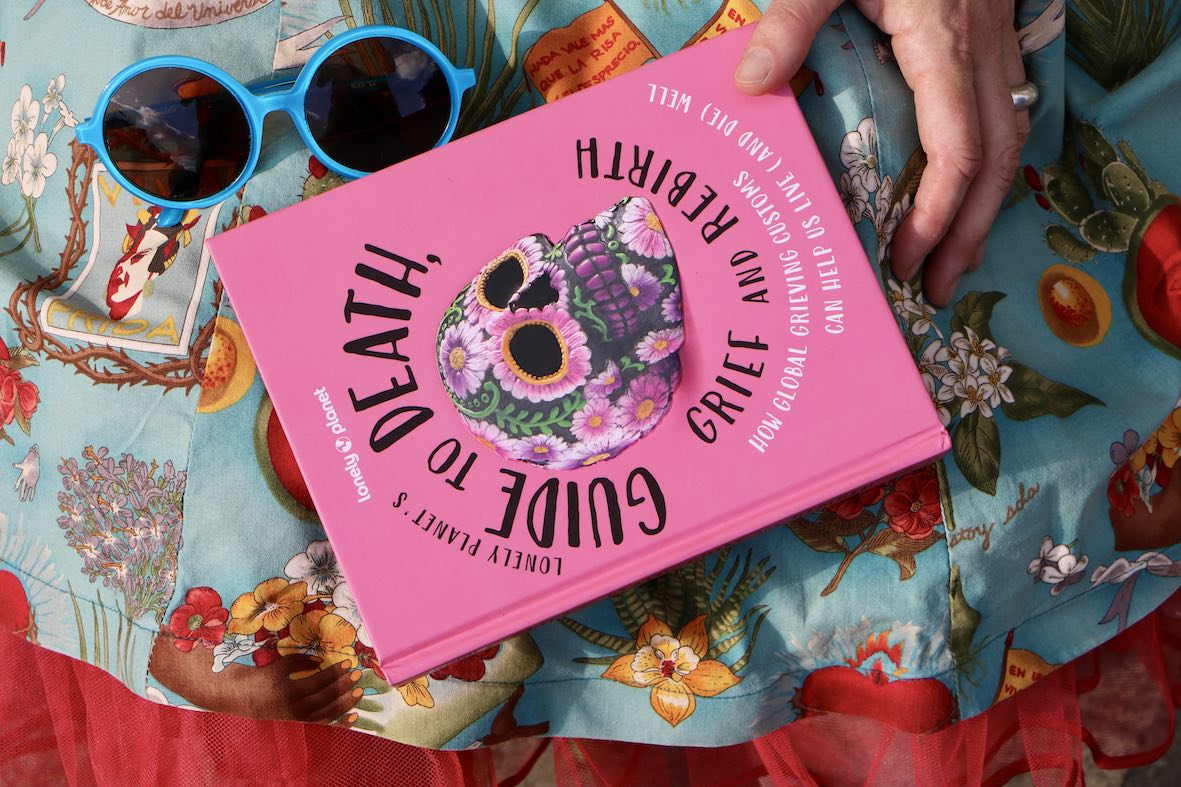
Book shown here as reviewed in the text, shown on a Mexican style print.

The Lonely Planet’s Guide to Death, Grief and Rebirth’ by Anita Isalska is a delicious buffet, to inspire the armchair traveller. It shows glimpses into a wide variety of global beliefs, customs and cultures focussing on death and mourning.

Unlike the usual format of a Lonely Planet Guide, this is thematic and informative, without the specific information needed for a trip. It is a delightful feast of colourful images and intriguing facts, like this one.
“A single human cremation produces as much carbon dioxide as an 800km car journey.”

‘The Lonely Planet’s Guide to Death, Grief and Rebirth’ tempts with travel destinations; where fascinating events take place at the end of a life. However, this book is also a provocation to consider how we will face our own end. A visit to Varanasi in India for example may be “a visceral reminder of the ultimate destination of life in a world that prefers to keep mortality from view.” And the book includes wise cautions that death tourism requires respect, sensitivity and serendipity.

For those who have grown up without traditions that feel supportive, there are plenty of other ways of being with loss named here. Different and sometimes more universal possibilities for grieving, and honouring our loved ones are gathered in by Anita Isalska, with an invitation to the possibility of exploring more openness around endings.
“Whether it’s an annual event, a support group or a place of remembrance (a monument or cemetery), being present with others who are experiencing loss can be a powerful way to reduce the loneliness of grieving.

This guide surveys some of the broader faith-based traditions. It also covers some of the practices that are being reimagined for a generation seeking more conscious ways to mourn; such as keening in Ireland and the re-emergence of death doulas.

In the contemporary grief theory of ‘Continuing Bonds (Klass, Silverman and Nickman) in which it is normal to have an ongoing relationship with deceased loved ones, modern psychology is playing catch up with “Mexico’s flourishing death culture”. And in Madagasca where “the natural instinct to communicate with, and care for, the dead can find expression and relief.” A relationship with ancestors “where loving bonds remain strong even after death,” is integral to many of the cultures in the book.

So many of the funerary practices described link both the past to present and the dead to the living in ways that help us to recognise we are all inescapably part of the cycle of life…and death. This book will be both food for thought as well as food for our ‘wise and well ancestors’.

Grief Tending in community, (which doesn’t get a mention in the book) is informed by the old ways of the Dagara Tribe in Burkina Faso. Find Grief Tending events happening in the UK, and online. They can also be found in many places around the world.

Sarah Pletts is a Grief Tender and Artist who offers workshops in London and online, sharing rituals where grief on all themes is welcome.  For more information about Grief Tending events see here

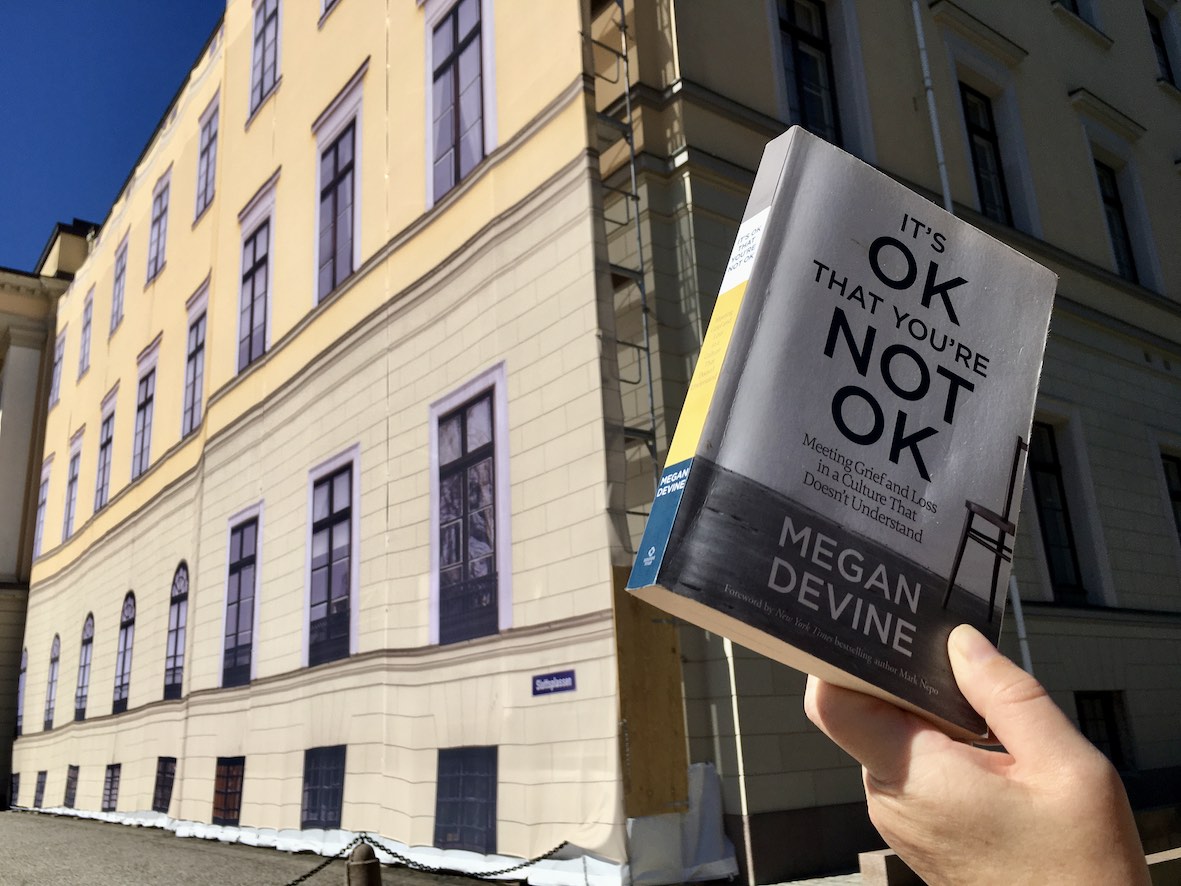
The book in the text is shown with the facade of a building to represent the masking of grief.

Megan Devine’s excellent book ‘It’s OK Not to be OK, tells how it is to grieve in a culture that avoids talking about death. She speaks plainly about the experience of sudden traumatic loss, and what may be behind the facade we show in public.

“No matter what anyone says, this sucks. What happened cannot be made right.”

‘It’s Ok That You’re Not Ok’ is also a primer for those who want to know how to navigate grief, and how to be with someone who is grieving. Megan Devine’s voice is refreshing. She speaks out in praise of “telling the truth about grief.” She makes clear the “wider cultural sweep of grief illiteracy”, and what we need to face, both personally, and more widely to bring about change.

In addition to the impacts that cause grief, other people’s mis-perceptions, and anxiety add insult to injury. This book invites us to look more closely at what’s behind the acceptable face of bereavement.

“Because we don’t talk about the reality of loss, many grieving people think that what’s happening to them is strange, weird, or wrong.” In addition to the grief stories Megan Devine listens to as a therapist, she also hears, “how painful it is to be judged, dismissed and misunderstood.”

The consequences of a pain-phobic culture results in widespread avoidance from facing global issues as well as personal situations, to our detriment. The argument that Megan Devine presents as our collective disconnect is essential to address for the wider good.

I would argue that Grief Tending in community is one of many much-needed antidotes. However, if being in a group process feels unmanageable at the moment, ‘It’s OK That You’re Not OK’ is a book that offers some practical ways to survive. She encourages us to look for support, and explore creative expression to tend to grief, rather than look for solutions to fix it.

One of the questions that people often ask is, “What should you say to someone who’s grieving?” The final section of the book presents a verbal took kit to answer that question. Whether you want to understand more about our systemic discomfort with grief, are dealing with loss and need a role-model, or want to learn the skills to be a better companion to those who grieve, this is a brilliant read.

Find Grief Tending events in London and online here, where we work with our own feelings in response to loss, change and absence, together in a group.

Sarah Pletts is a Grief Tender and Artist who offers workshops in London and online, sharing rituals where grief on all themes is welcome.  For more information about Grief Tending events see here

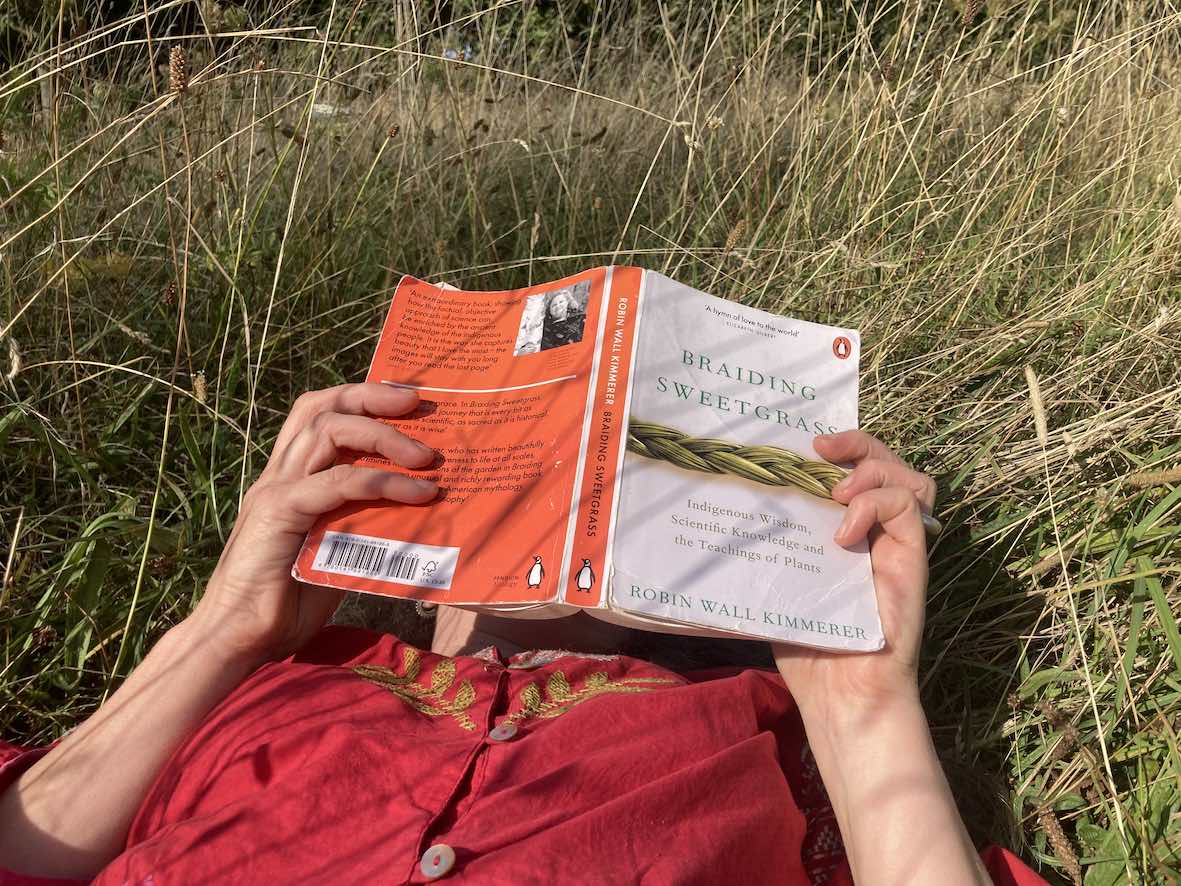
The book described in the text is shown in a meadow.

In Braiding Sweetgrass’, Robin Wall Kimmerer weaves together a practical understanding of indigenous teachings with environmental science, and stories of parenting. Her eye as a biologist, love and respect for plant, creature, and place meet her heart as a mother living through challenging times.

Recognising the richness of her heritage, (she is a member of the Citizen Potawatomi Nation), she invites us to grasp what has been lost through the deliberate repression and separation of Indigenous American people from their children in former generations, and what is now being reclaimed.

The stories in ‘Braiding Sweetgrass’, both handed down, re-told, and told anew, with her fresh perspective show the importance of living in right-relationship with land and the more-than-human world. The profound knowledge learned from nature is not exclusively for Shamans. This book reveals a way to experience deeply through observation, paying attention and inquiry. I was enchanted.

As I read this book, the significance of the ‘Honourable Harvest’ – taking only what you need – sunk in deeper as I foraged for berries, leaving half for other creatures and regeneration. This is book written with beautiful words that drew me in through descriptions of relatable encounters with nature. The sweet and sour of her insights make me look more closely as I step through the forest, nestle my feet in moss, watch rain-drops. I will drizzle maple syrup with a new reverence.

She does not shy away from these changing times:
“If grief can be a doorway to love, then let us all weep for the world we are breaking apart so we can love it back to wholeness again.” I am left feeling inspired and hopeful that we may learn to live in wise community with others of all species.

You can find Grief Tending events, which foster connection with nature and each other here.

Sarah Pletts is a Grief Tender and Artist who offers workshops in London and online, sharing rituals where grief on all themes is welcome.  For more information about Grief Tending events see here

The book in the text shown in a wild Norwegian sea and landscape.

Anam-Áire means one who cares for the soul. ‘The Last Ecstasy of Life – Celtic Mysteries of Death and Dying’, written by Phyllida Anam-Áire describes her approach to doing just this. She offers gentle guidance for those at the end of life, from her experience of sitting with the dying. She is now a therapist and author.

I have participated with Phyllida online, heard the music in her speech, and seen her gentle encouragement of people. She grew up in Ireland, became a nun, and then took a more mystic path away from the Catholic Church. She moved to Northern Ireland, worked with Elisabeth Kübler-Ross and developed her practice. She now lives in Scotland. Reading the words on the page, I hear her brogue, remember her assured presence.

Here she offers a metaphysical perspective steeped in the old Celtic ways, known as the ‘Cauldron of Brigid’. She teaches both living fully and dying consciously. Her very particular flavour weaves her understanding of life and death, in spiritual language with wise guidance and visualisations. She focuses on the energetic non-visible processes as death comes near.

Phyllida Anam-Áire encourages the reader to attend to their inner work, to process grief in order to live well ahead of our dying days. Key to this is the Celtic vision of the ‘Universal Heart’. Once we have found self-compassion, we can access a wider compassionate experience of love. She says “This opening into grief is the most important part of recognising the presence of the Universal Heart for, like joy, which cohabits with grief, it is always there, awaiting the unveiling and expressing of grief to reveal its presence.”

I like the emphasis she places on reclaiming our shadow parts and finding self-compassion; looking at our own grief and fears in order to become a non-judgmental compassionate witness to others. ‘The Last Ecstasy’ of the title is also a reclamation of the potential of shame-free pleasure in the body, and as a transformational framing of both birth and death.

Find Grief Tending events with Sarah and Tony Pletts and the Embracing Grief team coming up here.

Sarah Pletts is a Grief Tender and Artist who offers workshops in London and online, sharing rituals where grief on all themes is welcome.  For more information about Grief Tending events see here

Worry Monster packet shown to illustrate anxiety, which is normal before a Grief Tending workshop

I’m paying attention to the invitations that come my way, and am saying “Yes” to some of the ones that in the past would have scared me. Now I am observing a little tingle and taking a risk.

I’m expanding my stretch zone. It’s also known as the ‘magic’ zone. It’s the territory we invite participants to step into during our workshops. With practice, our stretch zone becomes more comfortable and grows. It is a place where our learning can take place at a manageable pace.

Anxiety is often one of the natural responses as part of the grief experience. However, if the events we offer seem too far out of your comfort zone to contemplate, it might be helpful to know that staying in your comfort zone is an option. Even if you choose to join one of our workshops, everything we invite people to do is optional.

In a Grief Tending workshop we definitely don’t want people to leap beyond their stretch into their terror zone. When things are terrifying it’s probably not going to allow your nervous system to engage and process in a helpful way. But if there’s a tinge of nervousness or excitement, maybe now is the moment to take one step out of your comfort zone and try something new.

Once someone has booked to come to a workshop, anxiety can build. It is not unusual for all kinds of imagined scenarios to unfold, and feelings to surface. People often report physical symptoms or tensions increasing in the days beforehand. Many people feel worried about the concept of speaking in front of a group. Although we offer many different kinds of exercises and only some of them may include speaking.

If your ‘Worry Monster’ is activated, it can be helpful to find out more about what will be involved, or the style of facilitation. If there is something specific that you need, or are concerned about, it’ a great idea to ask. Often people need to know that they can take care of their own needs in the environment, and a bit more information can help to settle their nerves. If you are contemplating coming to one of our workshops, I recommend watching the video ‘What Happens in a Grief Tending Workshop?’

For Grief Tending workshops and events coming up, please see here.

Sarah Pletts is a Grief Tender and Artist who offers workshops in London and online, sharing rituals where grief on all themes is welcome.  For more information about Grief Tending events see here

Image of the author, in a mood that reflects the theme of the text

Almost every morning for the last twenty years I have taken the dog for a walk. Now both dogs have died and I am coming to terms with a small shift in identity. I am no longer one of the dog people who say hello or chat because they have a dog with them. I love the permission that having a dog (or a child) gives to speak to others. I have got to know many people of all backgrounds through having a four-legged friend by my ankles. Now it may seem odd that I choose to walk in the rain, without the cover of a dog.

Loss is often coupled with questions of identity. People may not know what to reply when asked “How many children do you have?” after the death of a child. People report uncertainty in choosing how to respond to these painful innocent questions.

Likewise, when a partner has died there are no universal signals in dress, of being a remaining partner; although dressing as a widow is still practiced in some cultures. When a partner dies we may tick a new box in official forms, and it can be another reminder on top of many other losses.

When coming to the end of a working life (not always by choice), people may struggle with the absence of a work identity, particularly if it was associated with a dedicated career path. Each crossroads in life may come with these differences.

We may hold fixed stories in our heads about who we are. With change can come uncertainty. The narrative is disrupted, and we are required to make a new story that we tell about ourselves, and tell to others.

If we have chosen a life-changing identity shift, even when we are pursuing our dreams, there can be aspects of ourselves that we are leaving behind. As we celebrate the new, these parts of us may still need to be acknowledged and grieved as we say goodbye to them. There is a tendency to want to avoid endings of all kinds, to let them slip away un-noticed. When we let the completions in our life be marked, to be seen, it can help as we take the next step.

For Grief Tending workshops and events coming up, see here.

Sarah Pletts is a Grief Tender and Artist who offers workshops in London and online, sharing rituals where grief on all themes is welcome.  For more information about Grief Tending events see here

Image shows tree described in text in winter. Image by Sarah Pletts

When natural conditions prevail, Birch is the first tree that will grow on open land, beginning the cultivation of a woodland. Glennie Kindred holds much knowledge about both the practical and symbolic ways of trees.

“Birches are known as nurse trees, and their generosity and ability to nurture other trees and plants form part of their key signature picture. They do this via the nutrients and minerals that their root systems bring up from deep within the ground, and these are returned to the soil through their leaves as they shed them in the autumn, making the land fertile for other trees to follow”. From ‘Walking With Trees’ by Glennie Kindred.

Birch is the first tree in the ancient Irish alphabet too, the Tree Ogham (pronounced Oh-am). It is associated with new beginnings. If you look closely at a Silver Birch tree, you can find splits in the bark that resemble eyes or vulvas, which remind me of this connection with birth.

In the ancient world, Birch was aligned with the Goddess Brigid. The Birch tree’s gentle waving branches that reach down from her upright trunk resemble a caring mother figure, and is known as ‘The White Lady’ or ‘The Lady of the Woods’. I pass this particular statuesque Silver Birch regularly, and greet her with a silent nod. Unlike the Yew, a Birch lifespan is closer to that of a human, so this tree is a grand senior.

Becoming familiar with a particular tree through the seasons, is a good way into nature connection. If you are looking for a bit less digital time, and a bit more time outdoors, the start of the year is a good time to make small adjustments to your routine. A regular ‘sit spot’ can be a great way to practice this, without making any great effort to a particular meditation, but just a regular location to be for a short period of time and allow nature to be present too.

I keep an eye open for the many Birch species that line streets and light up parks and gardens. The Paper Birch with its dazzling white bark that peels like paper is particularly bright. If like me, you are unable to recognise many trees, the Woodland Trust now has an App to help to identify different species.

The energy of Birch brings healing, and a creative boost to the start of a project. This may include clearing uncertainty and looking at events from new perspectives. Flower Essences are believed to contain the vibration of a flower. Findhorn Flower Essences include Birch drops, if you are looking for another way to make a deeper connection with this tree.

What are you facing towards in 2024? As this new year begins, is there something that you would like to discover or develop? Can the upright intention of Birch, with its gentle, inclusive kindness bring the medicine of an open mind and inspiration as you step forward?  Wishing you well in all your endeavours.

Find our Grief Tending events coming up here.

Sarah Pletts is a Grief Tender and Artist who offers workshops in London and online, sharing rituals where grief on all themes is welcome.  For more information about Grief Tending events see here

Image of tree, described in the text, and theme of the text.

The yew has long been associated with the end of the year. The original ‘yule log’ was from the yew tree, now represented in chocolate. Both the word yew and yule share derivation with the Old Norse word jól, the name of a long winter festival of the sun.

I was introduced to the wisdom of Yew trees through Sam Lee, Chris Parks and Charlotte Pulver. They invited a group to sing and breathe under an ancient Yew, which was an enchanting experience.

The Yew Tree if left to its own devices will keep growing for thousands of years, and has a number of ways to regenerate itself. Hence it is a symbol of the eternal, of death and rebirth. It is the final letter in the old Irish alphabet, the tree Ogham. It’s bark, needles and berry seeds are all highly poisonous (although the flesh of the seed is not). As another reminder of death and regeneration, Yew is used as an ingredient in chemotherapy.

Through becoming more familiar with this tree species, I was inspired to visit was Kingley Vale Yew Forest in West Sussex. Weaving under the sweeping yew branches was magical. Meeting some of the ancient trees there under a shady canopy offered an invitation to slow down, to compare my short life in relation to their longer timeline of people and times gone before.

The end of the year can be a good time to review where we have been over the previous twelve months, to mourn the losses, celebrate our achievements and harvest the learnings. The Year Compass is a free online tool to explore a full review if you are looking for a reflection process. It also invites an orientation to what’s next. One of the questions that I like, is ‘What three places would you like to visit in the year ahead?’

On my list to visit for 2024 is the Yew tree in the churchyard of St Andrews Totteridge in North London, which is thought to be around 2000 years old. Yew trees are often found in churchyards, and may pre-date the current church building, marking an older site that was locally significant.

If we have the luxury of time off during the dark of winter time, it can be resourcing to go inward, to dream, to replenish ourselves with rest before the next cycle begins. I find a pause helpful – even when we are only able to take a micro-pause of one breath. Pauses allow us to digest experiences, to connect with our inner world, or another being. They provide us with a moment to gather ourselves before heading back into the world. This movement inwards can be a resource to help us to face the storm of life – whether near or further afield.

In Glennie Kindred’s book Walking With Trees’ , she invites us to step into a deeper enquiry.
“Walking with Yews inspires us to engage with our own abilities to transform, adapt and change. We can choose to start again by walking away from old life style choices or old ways of looking at things. We always have the choice to change our thinking habits and transform our beliefs. Each end, each death of the old, be it small or large, opens up a new opportunity for a new beginning, brings with it hope, and new possibilities waiting to unfold.”

Find our Grief Tending events coming up here.

Sarah Pletts is a Grief Tender and Artist who offers workshops in London and online, sharing rituals where grief on all themes is welcome.  For more information about Grief Tending events see here